
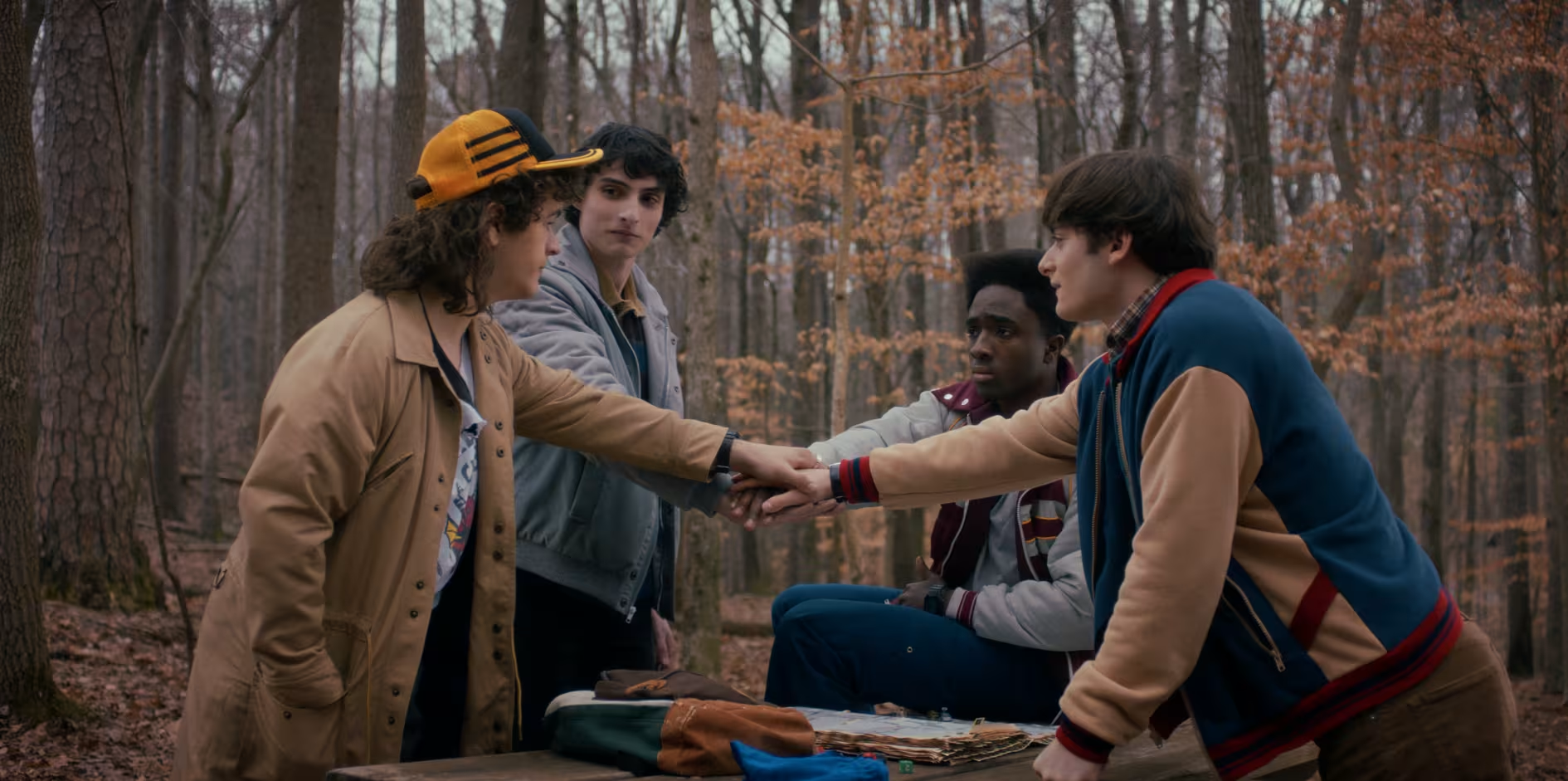
Just in time for Thanksgiving, “Stranger Things” Season 5 debuted on Netflix. Over the previous nine years, the popular series has generated significant revenue for the streaming service.
According to one industry assessment, “Stranger Things” has already brought in a billion dollars for Netflix. The more important question now is whether it can become a $2 billion one. Or perhaps something else entirely?
Given that Netflix (NFLX) released the fifth (and perhaps final) season of the venerable, horror-focused series on Wednesday, it’s no doubt a subject that many professionals in the entertainment and brand industries are considering.
In an apparent attempt to increase viewing, “Stranger Things” Season 5 will be released in three installments, each of which coincides with a major holiday. The night before Thanksgiving, the first four episodes went live. On Christmas Day, there will be three more, and on New Year’s Eve, the last one.
See also: Top picks for December 2025 Netflix, Hulu, HBO Max, and other streaming services
The season opening has generated a lot of excitement and talk. It was featured on the cover of Time magazine. Product tie-ins are common among food and restaurant firms (“Stranger Things”-themed Fruit Roll-Ups, anyone?). It goes without saying that viewers are scheduling time to binge-watch both the current and past seasons.
To put it briefly, “Stranger Things,” which began its first season in 2016, has evolved from a whimsical show with roots in pop culture from the 1980s to a worldwide phenomenon that now includes a book series, an immersive experience, pop-up shops, and even a Broadway production. In addition, an animated series is scheduled for next year.
Indeed, according to entertainment industry research firm Parrot Analytics, “Stranger Things” has brought in at least $1 billion for Netflix since 2020 alone.
The fifth and final season of “Stranger Things” will feature Millie Bobby Brown as teen superhero Eleven and David Harbour, left, as Jim Hopper.
Dani Calogera, a former Showtime executive who now manages the brand studio What/If Co., stated that “Stranger Things” is more of a contemporary media universe than a television program.
Take the fact that Netflix briefly had system problems on Wednesday when the first episodes of the fifth season went live, which appeared to be related to the spike in viewers, as evidence of the show’s enormous popularity.
The franchise’s continuation is not without danger, though, since Netflix is reportedly paying up to $60 million per episode for this fifth season, for a total investment of more than $400 million. With expenses comparable to those of blockbuster movies, it is undoubtedly one of the most costly television productions ever.
“‘Stranger Things’ is less of a TV show and more of a modern media universe.” Former Showtime executive Dani Calogera is the owner of the branding studio What/If Co.
Which leads us back to the question that has cost billions of dollars: Will the risk be worthwhile?
Both “Stranger Things” fans who may have let their subscriptions lapse after the series’ fourth season more than three years ago and interested individuals who may finally decide to watch the show for the first time (though they will obviously have some catching up to do) are expected to flock to Netflix in the short term as a result of the fifth season.
Industry insiders question whether there’s a possibility that viewers will become disinterested in the program. Since the main characters of “Stranger Things” have outgrown their cute teen selves, it’s the classic problem of “jumping the shark,” especially considering that the series’ original spark was fueled by their youthful sensibilities.
However, the majority appear to agree that the series is just too popular for it to occur.
According to Sunny Bonnell, the CEO of the Motto agency and a brand specialist, the program is “one of the few franchises that can still influence culture at scale.” According to her, Netflix may see a significant increase in subscribers and possibly even a $200 million increase in revenue from the fifth season.
What about the long term? That’s the short term. Experts think this is when things become complicated. “Stranger Things” might develop into another “Harry Potter” or “Star Wars”-style series, which has the potential to make billions of dollars over time. But now that the original series is nearing its conclusion, it all depends on what else Netflix can create to make it happen.
From tweens in 2016 to the older adolescents and young adults seen now, the youthful cast of “Stranger Things” has changed over time.
The Duffer brothers, who founded and are currently directing the “Stranger Things” franchise, have a four-year contract with Paramount (PSKY) that is said to include film, television, and streaming projects. However, they continue to be affiliated with Netflix and are working on two non-Stranger Things series: “Something Very Bad Is Going to Happen” and “The Boroughs.”
However, it’s evident that “Stranger Things” will continue after the fifth season. A much-discussed spinoff could be the next step.
Variety quoted Matt Duffer as saying, “We just want to make sure that if we’re gonna do it, it’s something that we’re very excited about.”
Theoretically, that spinoff might result in more, and more, and more. And that’s in addition to the ventures announced earlier, like the animated series.
After all, “Star Wars” started with a single film, but it has since given rise to other films and other endeavors, including Disney+ (DIS) series like “The Mandalorian” and “Andor.” Additionally, a film based on “The Mandalorian” will be released next year.
Experts predict that “Stranger Things” might become that multibillion-dollar franchise if it begins to take a similar course.
“At this point ‘Stranger Things’ behaves less like a series and more like a brand, and that means its financial runway extends well beyond the finale,” Bonnell stated.
In an earnings call earlier this year, Ted Sarandos, the network’s co-chief executive, stressed that despite “Stranger Things”‘ potential value to Netflix, the firm cannot depend solely on one show to drive its expansion.
The series “is about a steady drumbeat of shows and films and soon enough, games, that our members really love and continue to expect from us,” he stated.



