
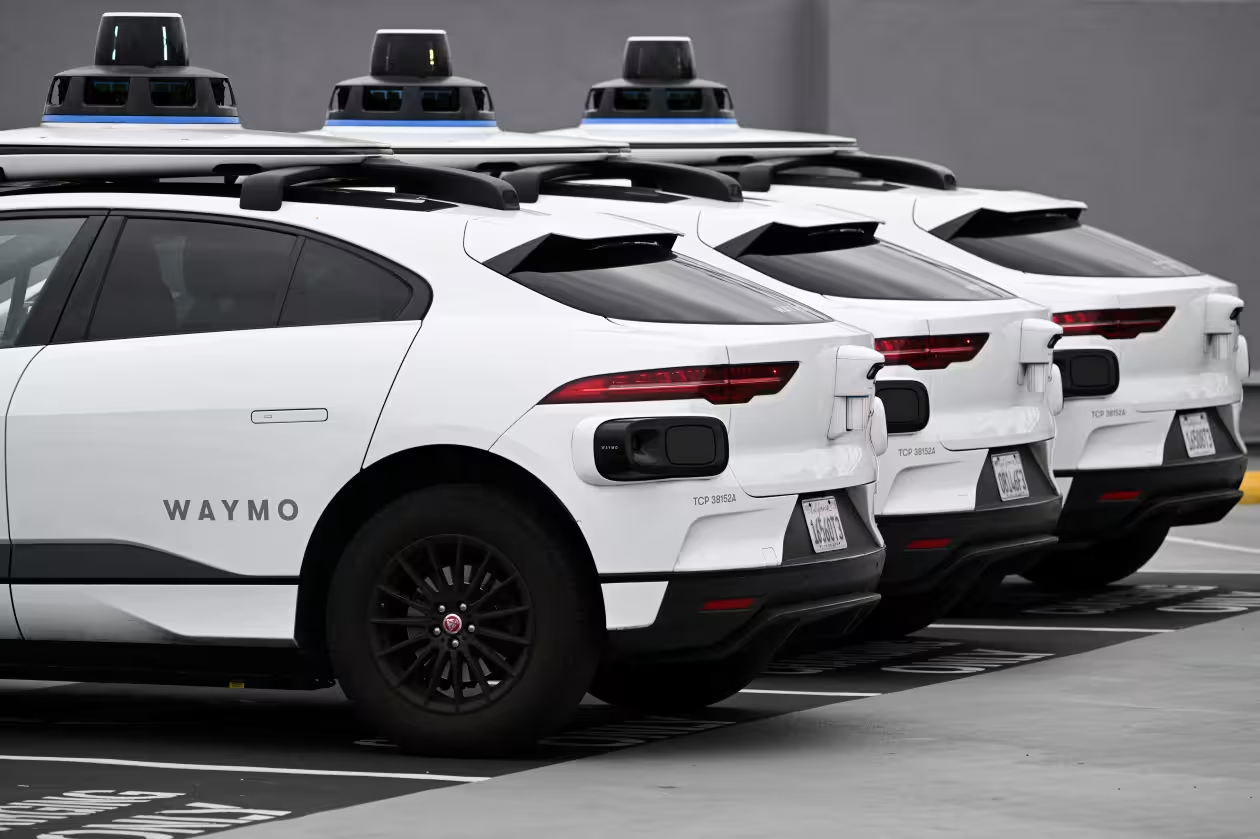
With 2,500 autonomous cars in five cities and 11 more locations named as objectives, Alphabet’s Waymo is spearheading the robotaxi movement.
Widespread adoption of driverless cars may seem like a pipe dream given that there are currently only a few thousand of these vehicles on the road. However, a world ruled by robotaxis may be closer than you may believe.
According to Morgan Stanley, people today spend a combined 82 million years in about 1.2 billion cars that travel 12 trillion miles a year.
According to the bank, 98% of all automobiles sold worldwide may be driverless by 2050. It is anticipated that at least 100 million cars in the United States alone will have software that enables them to function under certain circumstances without human input.
Leading the way in this technological revolution is Waymo, a firm supported by Alphabet (GOOGL), the parent company of Google. As of December, the company has over 2,500 vehicles transporting clients to and from destinations in five cities, with plans to expand to 11 other U.S. cities.
Additionally, a number of businesses in the United States are developing comparable services, including Tesla (TSLA), which plans to launch a completely autonomous ride-hailing service in Austin, Texas by the end of the month. These include May Mobility, which in September deployed its AVs on Lyft’s (LYFT) Atlanta network, and Zoox, a startup sponsored by Amazon (AMZN) that provides free rides in Las Vegas.
Waymo was established in 2016 as an independent entity after emerging from Alphabet’s Google X research and development lab. Tom Chi, a founding member of Google X, claims that optimization was the primary problem that first sparked the self-driving initiative. According to estimates, household cars are used at a rate of about 5%, which means that they are not used for 95% of their useful lives.
A fleet of robotaxis may significantly boost vehicle utilization by running constantly and employing algorithms to predict rider demand, which would lower the number of cars on the road and, in turn, traffic and pollution, Chi told MarketWatch. Chi is currently the founding partner of the venture-capital firm At One Ventures, having departed Google in 2012.
According to Canaccord Genuity, Tesla’s robotaxis might travel 1,000 miles each week by 2035—roughly four to five times the current average distance driven by a personal vehicle. An 80% decrease in the number of cars on the road would result from autonomous vehicles increasing utilization from 5% to 25%, which would allow one car to do the same amount of work that five cars currently do.
“Imagine that you have a city where you’ve used a quarter of the area for parking, and now imagine you’re able to get 80% of that area back,” Chi explained.
Roads that are safer
Every business has a different strategy, yet they have all promised customers something rather similar. The most important of these is the notion that using sophisticated software in place of drivers will greatly improve safety.
Over 39,000 people lost their lives in traffic accidents last year, according to figures from the National Highway Traffic Safety Administration. Furthermore, a 2015 NHTSA analysis of crash data revealed that driver error, not vehicle failure or environmental conditions, was responsible for the great majority of crashes.
Companies that make autonomous vehicles anticipate a time when the majority of people won’t need to touch a steering wheel, and they contend that doing away with drivers will significantly reduce risky circumstances. And the information they have made public does support that claim.
Waymo claims that its cars were involved in 90% fewer incidents that resulted in significant injuries than cars driven by humans, based on 127 million miles driven entirely autonomously. Based on statistics from more than 6.9 billion miles driven with the software, Tesla asserts that the use of its sophisticated driver assistance system has led to seven times fewer serious collisions.
However, no technology is flawless.
Tesla is presently under investigation by the NHTSA for allegedly breaking traffic safety regulations, some of which are said to have caused collisions. The NHTSA concluded a 14-month investigation into a string of minor crashes involving Waymo robotaxis over the summer, but the agency is still looking into Waymo vehicles circling stopped school buses.
When a robotaxi knocked over a tiny dog a few weeks after one of Waymo’s cars inadvertently killed a beloved bodega cat in San Francisco, the media went into overdrive. According to Waymo co-Chief Executive Tekedra Mawakana, it’s only a matter of time until a Waymo robotaxi directly kills a human.
At a TechCrunch conference in November, she stated, “I think that society will” tolerate a robotaxi-related death. “I think the challenge for us is making sure that society has a high enough bar on safety that companies are held to.”
Encouragement of ‘autonomy in humans’
Time is a constant in every pitch to customers, aside from safety.
Adam Rodriguez, General Motors’ (GM) president of AV products, told MarketWatch earlier this year that the company’s quest for hands-off, eyes-off driving software is essentially a product where you can sit back [and] do something else with your time.
RJ Scaringe, CEO of Rivian Automotive (RIVN), recently stated, “This gives you your time back,” in reference to his company’s plans for comparable technology.
Additionally, Elon Musk, the CEO of Tesla, proposed that autonomous vehicles may be compared to miniature lounges during his “We, Robot” event in 2024.
“You can do whatever you want while you’re in this comfortable little lounge, and when you get out you will be at your destination,” Musk stated.
While using a bus or train might need an additional walk or drive (or, based on a recent Waymo consumer survey, a connecting robotaxi ride), that isn’t all that different from most other public transportation. Robotaxis is unique because it provides a level of seclusion that is unavailable in ordinary taxis or on congested subways.
Waymo’s ridership isn’t limited to the usual young, wealthy early adopter, according to Kerry Brennan, a manager on the company’s product and customer research team. She claims that a large portion of Waymo’s users are those who, for various reasons, are unable to drive themselves or find using public transportation or traditional ride-hail services uncomfortable.
“I always like to say we’re working on building autonomous driving to support autonomy in people,” added Brennan.
Slowly, that is also being extended to kids. Waymo has launched accounts for some teens in Phoenix that require parental consent, even though it won’t allow parents to transport children of any age to school or soccer practice (though not everyone has fully adhered to that requirement).
Although some people will gain more autonomy via robotaxis, others may lose their jobs as a result. It is anticipated that at least part of the millions of drivers and couriers currently employed in the United States will be replaced by driverless cars as operation costs decrease and more become available.
Uber Technologies (UBER) CEO Dara Khosrowshahi stated in September that driver unemployment “is going to be a real issue” in ten to fifteen years. David Risher, CEO of Lyft, recently told Fortune that autonomous vehicles won’t take the role of human drivers for “years and years and years” to come.
However, the International Brotherhood of Teamsters and other labor organizations are not eager to wait and watch how the business develops. Government action to oppose AV growth has been demanded by unions nationwide.
“This isn’t about innovation,” Michael Ortiz, a Republic Services driver and Teamsters union member, stated during a Boston City Council hearing in October. “This is about who gets to have food put on their tables, a roof over their heads.”
Improved communities
The effects of autonomous vehicles may extend well beyond the transportation sector. As driverless cars encourage people to relocate from cities to the suburbs, following the trend initiated by the pandemic and the advent of remote work, Stanford economist Nicholas Bloom sees the technology revolutionizing the real estate market.
Bloom emailed MarketWatch, saying, “This has massive benefits as it will make housing cheaper by spreading people out, with bigger yards, more parks and leisure space.”
The dynamics of real estate pricing may be totally upended by such a development, he warned, since properties close to highways and outside of urban areas might see price increases while those near existing transit hubs would see price decreases. For younger Americans who are mainly excluded by the dearth of reasonably priced entry-level homes, it would be a game-changer in the U.S. housing market, which is beset by unaffordability and a shortage of supply.
Chi said that suburban residents may recover their garages and turn the square footage into residential space if individual car ownership drops.
The advantages are not limited to the suburbs. Autonomous vehicles have the potential to transform urban areas into denser, more walkable communities by improving traffic flow and decreasing the need for parking.
“When we talk about the future here, it’s not just that people can commute farther and they can nap in the car,” Chi stated to MarketWatch. “I believe it will completely change the way cities are constructed. We could create more homes and lower the cost of living in cities if we so desired.
According to Chi, real-time ridership data might also be used to inform policy, enabling communities to strategically locate new public transportation hubs in response to genuine demand.
A technology that promises radical social transformation won’t be easily embraced, and Bloom anticipates that the new technology will be accompanied by legal, insurance, and regulatory obstacles.



