
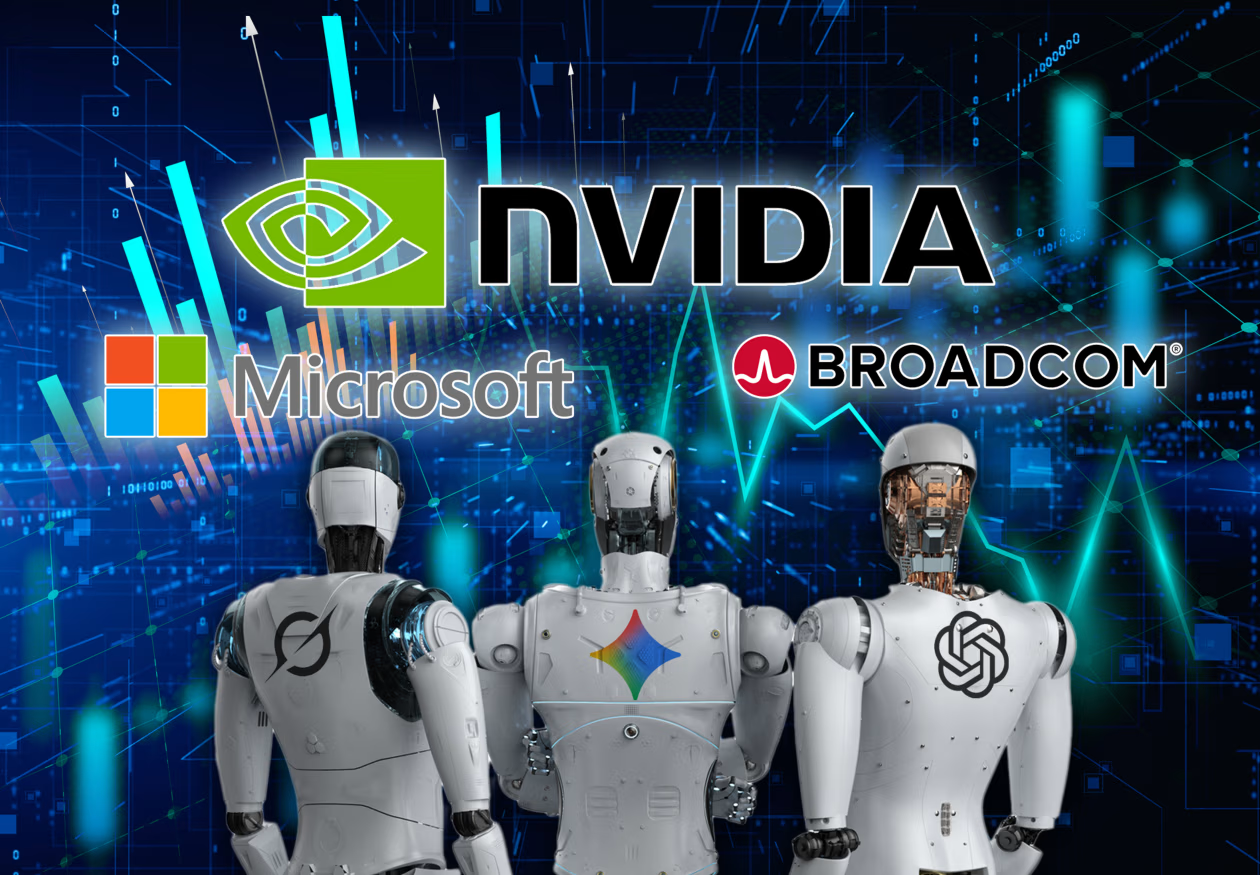
The top AI models all agreed with Nvidia, but you should do your own research.
A machine must be able to learn and apply knowledge at a level that is on par with or better than that of humans in order to be considered artificial general intelligence, or AGI.
AI has already mastered several tasks, even though the technology isn’t quite there yet and the existence of AGI is up for question. For example, for nearly thirty years, computers have outperformed humans in chess. Additionally, this year’s International Mathematical Olympiad, the global championship math competition for pre-university pupils, saw both Alphabet’s (GOOGL) (GOOG) Google Gemini and OpenAI’s ChatGPT achieve gold medal-level performance.
Is stock picking the next big thing?
Even people who pick stocks for a living are not very adept at it. Roughly 90% of active public-equity fund managers underperform their index, according to a 2024 S&P Global analysis.
Therefore, we made the decision to test the leading large language models, or LLMs, by asking them to predict which tech stocks would perform the best in 2026.
OpenAI’s ChatGPT, Google’s Gemini, Anthropic’s Claude, and xAI’s Grok chatbots were given the following prompt by MarketWatch: “You are a technology portfolio manager looking at opportunities for 2026.” Please list the top five tech stocks you believe in for the upcoming year.
To get past LLM restrictions, we used a role-playing framework rather than a direct query. Claude refused to respond when asked for a list of “stock picks” without providing the hypothetical context, claiming that it is “not a financial advisor” and is unable to provide investment advice.
Both Claude and Gemini urged conducting independent research and added a warning that they were only participating in a role-playing exercise and were not providing actual investing advice. Grok advised people to “always consult a financial advisor for personalized advice.”
The consensus choice was Nvidia (NVDA), which was not surprising considering that it is the leading provider of AI chips that power the most sophisticated models in the world. The chatbots flagged some of its fellow “Magnificent Seven” equities, including Microsoft (MSFT), which are also customers of the chip maker.
In response, Claude reiterated his “deliberate overweight to semiconductors,” stating that infrastructure names are “where the most durable moats and visible demand trajectories lie.” Claude, like many others on Wall Street, stated that it anticipates the AI rollout to continue in 2026 and that AI firms would begin to concentrate more on inference—the process of executing AI models after they have been trained—as well as on efforts to monetize their products.
By adding software firms Palantir Technologies (PLTR) and CrowdStrike Holdings (CRWD), Gemini, on the other hand, added some diversity and cited AI applications as the next major beneficiary of the market frenzy. “We are no longer just buying the shovel makers; we are buying the companies that are successfully turning electricity into intelligence at scale,” Gemini stated of its investment plan for 2026.
ChatGPT recommended a 50% to 60% exposure to “core growth” firms including Microsoft, Amazon.com (AMZN), and Nvidia, with the remaining portion going to chip manufacturers Broadcom (AVGO) and Advanced Micro Devices (AMD). Additionally, it identified “emerging quantum/AI startups” and other specialized AI infrastructure plays as possible watchlist names.
In contrast, Claude stated that it was not “chasing momentum names without earnings,” citing “quantum-computing plays” and “speculative AI software” as examples.
With Oracle (ORCL), whose stock has been severely impacted in recent months due to concerns about its debt levels and affiliation with OpenAI, Grok made a daring decision.
The method via which LLMs “reason” can clarify how each of these chatbots came to its own judgments. Developers give the model enormous volumes of data up until a predetermined cutoff date during the first training phase, which the machine then splits into “tokens,” or individual words or phrases. Through a process known as “next-token prediction,” the model regularly learns to guess which word in a sequence is most likely to come next. Eventually, this process makes the mathematical “weights,” or connections, between related concepts stronger. For instance, “Nvidia” is closely linked to “AI.”
Models differ when researchers change their weights to favor particular outcomes, even when they were trained on similar datasets. Claude’s inclination to ignore financial inquiries may be strengthened by Anthropic’s emphasis on safety. In contrast to other LLMs impacted by what Musk has referred to as “the woke mind virus,” Elon Musk’s xAI has purposefully positioned Grok to be “maximally truth-seeking.”
“If you look at the math of these models or how they’re constructed, they’re just predictable probability distributions,” techie Sergey Gorbunov, who co-founded the blockchain-infrastructure platform Axelar, was previously quoted by MarketWatch on LLMs.
This implies that LLM-generated solutions are only likely answers rather than necessarily accurate ones. Additionally, the training data is out of date if the LLM is not able to browse the web like more latest ChatGPT versions.
Consider the recent study “The Memorization Problem: Can We Trust LLMs’ Economic Forecasts?” by academics at the University of Florida. While doing the study in 2025, the researchers stopped using ChatGPT-4o’s training data in 2023 and asked it to forecast future economic events, such as interest rates and unemployment figures. Additionally, they prohibited the model from using the internet.
When ChatGPT-4o was unable to access the data it was trained on—its remembered knowledge base—the team discovered that it was making predictions that were almost random.
The industry has come to believe that LLMs are merely prediction engines and that scaling laws—the principles that demonstrate how LLMs get better with more training data and processing power—are no longer relevant.
LLMs are not the kinds of AI models that will achieve superintelligence, the point at which AI models will be thought to have surpassed human intelligence, according to those who think they will meet a scaling limit.



