
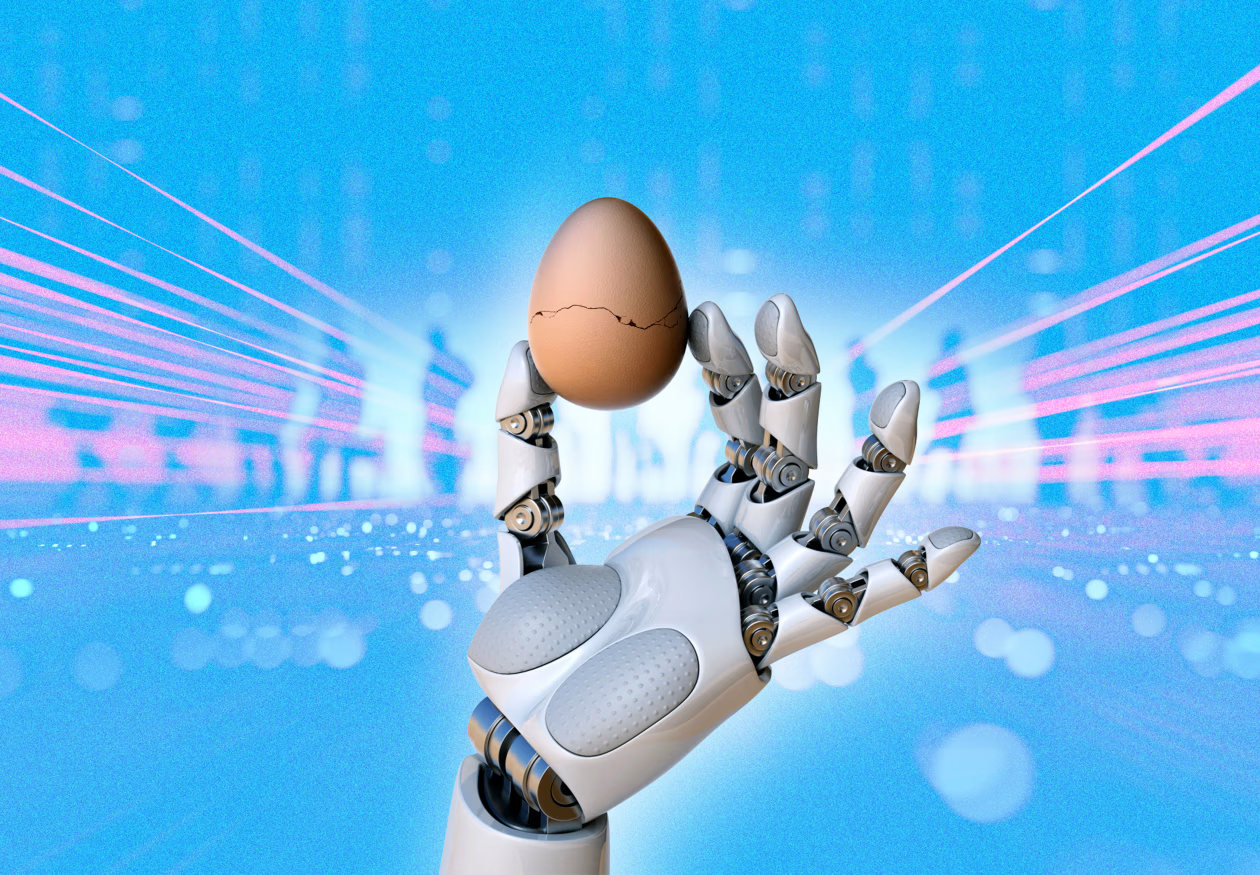
It is anticipated that humanoid robots would be used in homes and factories to do both simple and possibly complex activities.
It is now easier than ever to introduce human-like robots into factories and homes. However, completely autonomous humanoid robots are still years away, despite the claims made by an increasing number of firms.
There are several valid reasons for this, the most important of which is that creating a decent robot—much less a humanoid one that can function independently—is extremely challenging.
“Humanoid robots are so hard,” recently stated Brett Adcock, the founder of the robotics startup Figure AI. “Both the dynamics and high dimensionality make it such a highly complex system-level problem.”
According to Morgan Stanley’s forecasts, fewer than 1 million humanoid robots will be sold in the United States by the end of the decade, and it won’t be until after 2036 that more than 1 million will be sold in a single year, even though some companies plan to increase their efforts over the coming years. However, Morgan Stanley believes the sector could be valued over $5 trillion by 2050.
The majority of humanoid robots are still in the early stages of research, according to Alberto Rodriguez, director of robot behavior for Boston Dynamics’ Atlas humanoid. Companies are concentrating on determining how to improve and implement their technology.
“Assuring reliability is the biggest issue holding robotics companies back,” Rodriguez added. After all, if a robot can’t keep up with humans, what good is it to place one in a house or on the work floor?
According to Rodriguez, “it’s the most important mission” of contemporary robots, and thousands of Atlas units won’t be deployed in the field for roughly four years. Hyundai Motor Group (KR:005380), the company that owns Boston Dynamics, intends to purchase and use “tens of thousands” of its robots for industrial uses in the upcoming years.
Humanoids—why?
Humanoid robots have dominated our science-fiction fantasies for decades, from C-3PO to the Terminator. Nonetheless, some specialists believe that the obsession with the human form is somewhat misguided.
According to Tom Chi, a founding member of Alphabet’s (GOOGL) (GOOG) R&D factory Google X, where he worked on self-driving cars and Google Glass, optimizing a robot to look like a human frequently results in the robot doing poorly at specialized tasks. Chi cites the Roomba, a basic disc that can clean floors far more effectively than a humanoid robot at a fraction of the cost, as an example. Chi is currently a founding partner at At One Ventures.
Similar opinions were voiced by Andrew Anagnost, CEO of the engineering software company Autodesk (ADSK). According to Anagnost, some industrial robots can function effectively without resembling humans, as MarketWatch reported. “Rather than retrofitting humanoids into human spaces, it’s often more efficient to design a factory around the capabilities of specialized machines,” he said.
Others contend that it makes sense to create robots that will eventually be able to fit into new settings that were created by humans for people. Investment in over a dozen businesses developing humanoid robots has also been fueled by the prospect of reproducing a future that was previously only truly seen in science fiction.
However, there are significant challenges facing the business, such as safety, which roboticist Christian Hubicki stated is one of the most difficult topics “in all of robotics.” On that front, researchers have a lot to think about, such as how to identify people or even pets and stop robots from falling in a way that could hurt someone.
Additionally, given that businesses intend to place humanoids alongside workers on production floors, there is the problem of a robot being aware of its own strength. Last month, a former engineer filed a lawsuit against Figure, a firm valued at $39 billion, alleging that a broken robot “carved a one-quarter-inch gash into a steel refrigerator door.” The engineer’s assertions have been refuted by the corporation.
Additionally, companies are finding it difficult to solve hardware issues. For instance, Tesla’s (TSLA) Optimus humanoid, which is anticipated to enter production next year, has struggled to replicate the human hand, which some have dubbed the “last-mile problem” facing the industry.
According to Charles Dhong, a professor at the University of Delaware who studies touch replication, this is due to the intricacy of both the human hand and the human sense of touch.
Elon Musk, the CEO of Tesla, stated, “It’s an incredibly difficult thing, especially to create a hand that is as dexterous and capable as the human hand,” during an October earnings call. “The human hand is an incredible thing.”
The human hand with all five fingers isn’t “necessarily the optimal configuration” for a robot, according to roboticist and dean of Ohio State University’s engineering school Ayanna Howard. She said that it’s crucial to comprehend how human hands can grab an object and then apply that knowledge to the chosen synthetic limb.
Some have pledged to create five-fingered hands that resemble those of humans, including Tesla, Figure, and 1X Technologies. Some have chosen to use more human-inspired strategies.
In order to help its Atlas robots grasp objects, Boston Dynamics gave them “grippers” with only three fingers, one of which can rotate to act as a thumb. Instead of using hands at all, Agility Robotics, a company that specializes in creating humanoids for industries, attached tools directly to the arms of its Digit robot.
Artificial intelligence will probably require more developments. Anagnost contends that the lack of spatial reasoning in today’s top large language models prevents them from being able to power humanoid robots. Although LLMs are capable of predicting the next word in a sequence, they lack a grasp of physics and are unable to see and interact with three-dimensional objects and locations.
According to Anagnost, that is “something that language is never going to solve,” Rather, an increasing number of AI researchers are investigating “world models,” or AI capable of processing and absorbing vast amounts of sensory data. The “next frontier” for the industry, according to Anagnost, is the work of Fei-Fei Li, a professor at Stanford, and her firm, World Labs.
Boston Dynamics is creating huge behavior models—a kind of artificial intelligence system that focuses on reproducing particular actions—for Atlas. According to Rodriguez, teleoperation—the remote control of robots—is a major tool used by researchers to gather data for processing.
Many players, including Tesla, employ that time-consuming approach, which necessitates mass job repetition in order to gather data. Other approaches that businesses have looked into include training using simulations and synthetic data, which can yield more inaccurate findings but are easier to scale.
Sunday Robotics, a startup that only recently exited stealth mode, says it has a more efficient method than traditional teleoperation. By using custom gloves that mimic the hand of its Memo robot and employing workers in various homes to complete tasks, CEO Tony Zhao says costs can be dramatically reduced.
According to Zhao, his company’s approach also provides better feedback on how much force is needed for tasks like folding socks. That can be a game changer when training robots for more delicate processes, such as picking up wine glasses or putting away eggs.
Ready for testing
Despite glaring issues, it’s never been cheaper to get a humanoid robot. Just don’t expect them to be very useful.
Most cheap full-sized humanoids come from companies based in China – such as Unitree Robotics, which sells some models for just thousands of dollars. There’s also a market for smaller robots, such as Beijing-based Noetix Robotics’ child-sized robot that costs less than $1,500. Although consumers can purchase such products, they’re most often being bought by researchers or hobbyists.
“This is a very new phenomenon and it is really help[ing] push the field forward, because now anyone basically could have a humanoid robot to play around with,” said Hubicki, a professor at the Florida A&M-Florida State University College of Engineering. “That’s only been good for the field.”
While most U.S. companies have yet to slap a price tag on their humanoids, a handful have a rough estimate of what they would charge for a stay-at-home robot. Tesla wants to sell Optimus for between $20,000 and $30,000, Musk has said.
1X Technologies has started taking $200 deposits for its home robot, Neo, through an early-adopter program. The California company is offering the humanoid for either a one-time $20,000 payment that comes with a three-year warranty, or for a $499-per-month subscription.
But there’s a catch: The reportedly clumsy, but cozy-looking, robot will be controlled at times by a 1X teleoperator. According to the Wall Street Journal, which tested Neo in October, Neo is not smart enough yet to operate totally independently.
Bernt Børnich, the company’s CEO, told the Journal that Neo should be capable of doing “most things in your home autonomously” next year, but that the quality may not match what humans are capable of. 1X will also have safety guardrails to ensure customer privacy, he said.
Sunday Robotics is another company planning to put limited quantities of humanoids in U.S. homes next year. It’s started a free beta program that consumers can apply to join, with trials set for late 2026. Sunday says it costs about $25,000 to make its Memo robot prototypes, but that should be cut down to less than $10,000 as it scales production.



