
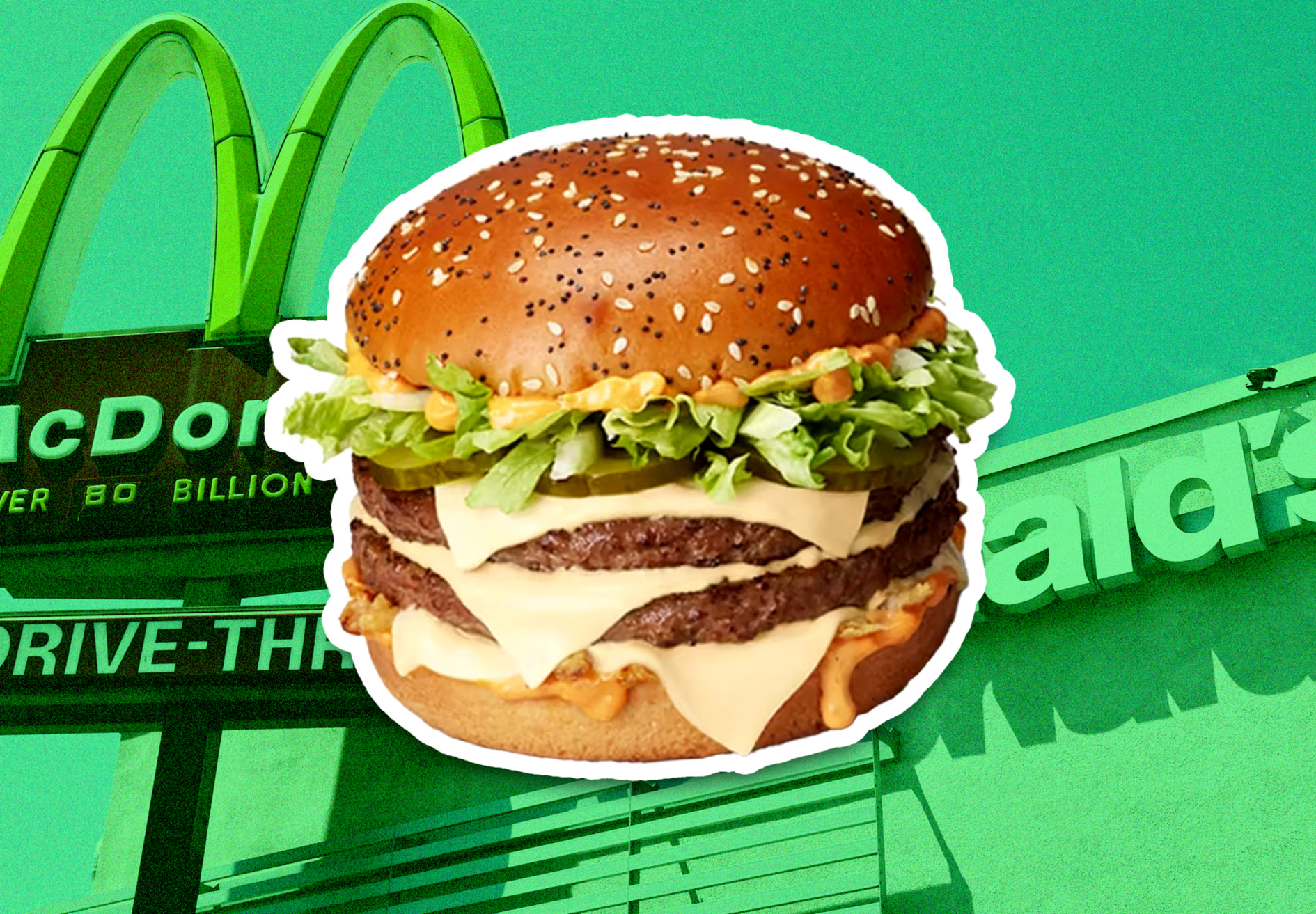
On a poppy-and-sesame-seed bread, the McDonald’s Big Arch burger consists of two beef patties, three slices of white cheddar, lettuce, pickles, onions, and a sauce known as Big Arch.
Is the half-pounder the replacement for the quarter-pounder?
McDonald’s (MCD) plans to launch their beefy Big Arch burger in the United States in early March, according to a number of reports. Already a mainstay on McDonald’s menus in other countries, the plus-size sandwich contains two beef patties – apparently weighing in at 8 ounces combined – along with three slices of white cheddar cheese, lettuce, pickles, onions and something dubbed Big Arch sauce, all on a poppy-and-sesame-seed bun.
It adds up to 1,057 calories of burger feasting, citing the British McDonald’s website, which is more than three times the calorie content of the ordinary McDonald’s cheeseburger (303 calories) and roughly double the count of a Big Mac (509 calories).
Other fast-food and fast-casual restaurants have recently introduced their own substantial offerings, so the bigger-burger narrative is not exclusive to McDonald’s. In November, Carl’s Jr., a brand known for its hearty offerings, debuted the Cali XL burger, which consists of two 3.5-ounce beef patties. And Shake Shack (SHAK) pulled out a Big Shack burger, which features two 4-ounce beef patties, as a limited-time item last fall.
And even although Burger King (QSR) hasn’t created any new supersize burgers recently, it does offer customers the option to raise their Whopper game by making the sandwich a Double Whopper or even a Triple Whopper with additional patties. There are an astounding 1,170 calories in the Triple version.
The notion is that even if a bigger burger costs more – the Big Shack, for example, was priced at $9.99 – the customer is getting plenty of bang for their dollars. Think of it as a food psychology game.
Americans have been infatuated with enormous quantities for a long time, and some think this is even more obvious when they are feeling the economic pinch: Think the current issues regarding affordability, as well as concerns about the high expense of dining in restaurants. “Joel Thomas Blackstock, an Alabama-based clinical social worker and therapist, said, “It feels like you are actually winning one over on the system when you see a huge burger that is heavy in your hand.”
Burger fans are quick to remark that more is, well, more when it comes to the American classic. “A bigger burger is going to get the job done. It offers fullness,” said Paul Whitten, a self-professed burger aficionado who operates a Nashville-based tour company.
From a restaurant’s point of view, there’s money to be made with these bigger burgers, despite the fact that beef prices have been growing.
Stephen Zagor, a restaurant-industry analyst who teaches at Columbia University’s business school, says that’s partially because the fixed costs for a restaurant – everything from labor to the energy bill – remain the same no matter how many patties are on a burger. Since the only additional expense for the restaurant is the patty itself, which can be passed on to the customer, adding more beef usually results in a healthy profit.
According to Zagor, fast-food chains have never made a lot of money on burgers. “They make their real money on french fries and drinks,” he stated. Ultimately, if a bigger sandwich gets customers in the door – and those diners accompany their purchase with a side of fries and a beverage – then it all works out to a restaurant’s advantage, he added.
Those are arguments echoed by Mark Kalinowski, a longtime fast-food industry analyst. He is particularly optimistic about the Big Arch’s future, stating that he believes the burger has the potential to become a McDonald’s staple and one of its billion-dollar menu items. He also doesn’t anticipate the Big Arch will significantly cannibalize sales of other popular burgers, such as the Quarter Pounder and Big Mac. “This should perform very well for them,” Kalinowski said of the Big Arch, adding that he’s heard from sources that it will be sold in the U.S. starting March 3.
McDonald’s informed MarketWatch that it has no information regarding a Big Arch introduction in the United States, but it did point out that the burger had been offered in several foreign regions last year, including Germany, Portugal, France, Switzerland, and the United Kingdom.
Not that anyone is acting as though larger burgers are inherently healthier. They do, of course, contain more protein, and recent guidelines from Robert F. Kennedy Jr.’s Department of Health and Human Services show that protein has become a nutritional focus.
But bigger burgers also come with extra calories, fat and sodium, nutritional experts add. For instance, the Big Arch’s 1,057 calories may be nearly or even more than half of the recommended daily caloric intake.
Does that imply you can’t ever indulge in a Big Arch or another bigger burger? Not necessarily, says Kezia Joy, a licensed dietitian, nutritionist and medical adviser at Welzo, a healthcare platform. “If you want to integrate large burgers into your healthy eating plan, enjoy them every now and again, and make sure to match them with other smart choices,” she advised.
To put it succinctly, Joy advised choosing water over drink while still enjoying your larger burger. And don’t eat the fries.



