
Israel, U.S. Launch Strikes on Iran: Middle East Crisis Escalates
Israel and the United States have launched coordinated attacks on multiple Iranian targets, prompting Iran to retaliate with missile strikes against Gulf countries. This rapid escalation has heightened tensions across the Middle East and raised concerns about global stability.
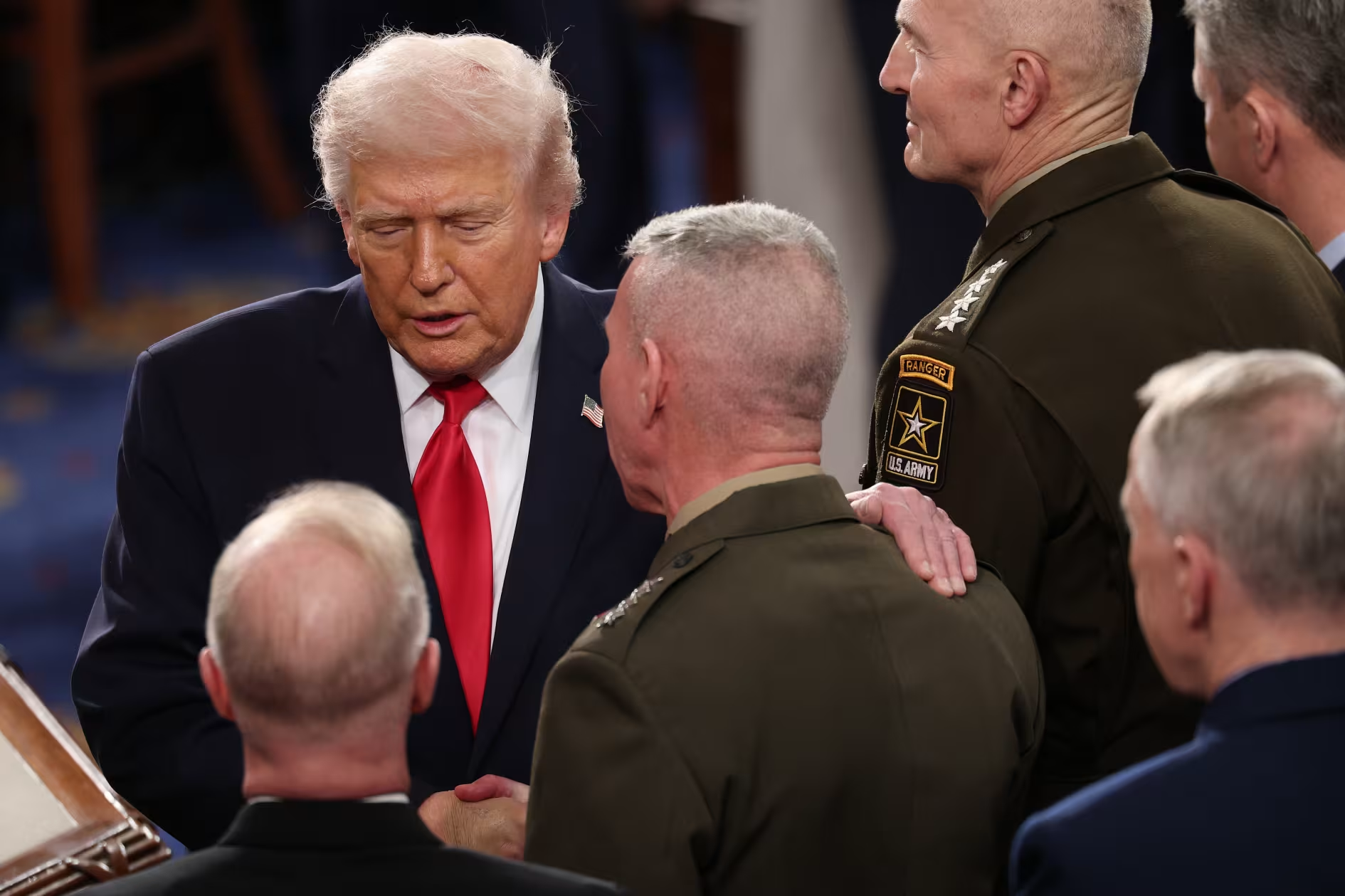
When President Donald Trump arrived to give his State of the Union speech on Tuesday, he greeted the Joint Chiefs of Staff.
Rising Oil Prices and Economic Impact
Oil prices are expected to rise due to the ongoing conflict with Iran. If this trend continues, experts suggest that the Federal Reserve may hike interest rates to combat inflation, potentially affecting global markets.
Political Pressure on Iran and Regional Stability
President Donald Trump has demanded significant changes from the Iranian government. Experts warn that the regime’s survival may be at risk, increasing the likelihood of further regional instability.
“The Iranian regime “is going to do anything they can and whatever they believe would assist them stay in power,” stated Suzanne Maloney, director of the Brookings Institution’s foreign-policy program, during a Chicago Council on Global Affairs event this week. “That does include striking both their neighbours, against energy infrastructure in the region, and, of course, against Israel and the U.S. military and any other presence in the region.”Following the US military action in Iran, this might be a very dangerous time.
War’s Impact on U.S. Inflation and Interest Rates
The war is expected to raise inflation in the U.S. economy. Boston College economist Brian Bethune told MarketWatch that “the case for lower rates is simply dissolving before our very eyes.” High prices are being driven by both the Trump administration’s tariff policies and rising oil prices.
The Fed has had difficulty controlling inflation over the last few months amid pressure from markets and the White House to lower interest rates. The central bank’s problems are further worsened by recent events in the Middle East.
Infuriating Federal Reserve officials who had thought that Trump’s new import taxes would only have a temporary effect on inflation, wholesale prices began to increase in December and are already running at a 3% annual rate. In a LinkedIn note, former BofA Securities head economist Ethan Harris predicted that the rise in producer costs will soon impact consumers.
Economist Predictions: Inflation and Consumer Prices
Scott Anderson, chief U.S. economist at BMO Capital Markets, predicts rising inflation in the first quarter. Before the impact of the Iran strike, core personal consumption expenditures could reach their highest level in two years, at a 3.1% annual rate—well above the Federal Reserve’s 2% target.
According to Anderson, consumer price inflation will increase by 0.2% to 0.4% over the next year for every $10 increase in crude oil prices.
Oil Price Surge in 2026
As of early 2026, WTI crude oil futures (CL00) (CLJ26) have surged by nearly 16%, or $10 per barrel, reflecting the global market’s response to the conflict.
According to Anderson, a protracted confrontation might increase the likelihood that the central bank will hike interest rates as its next course of action. Oil prices were already climbing as tensions with Iran increased. When it comes to controlling inflation, you’re actually talking about issues for the Fed,” Bethune stated. “In this situation, the Fed can’t lower rates.”
This year, traders in derivative markets continue to anticipate two quarter-point rate cuts: one in June and one in September.
Oil prices and tariffs both cause supply shocks that make it more difficult for the Fed to lower the cost of commodities used in economic production.
By encouraging businesses and consumers to spend more or encouraging them to cut back, the Fed’s interest-rate toolkit primarily affects the demand side of the economy.
Iran’s Retaliatory Strikes and Oil Market Response
As Iran strikes its neighbors, oil prices are expected to rise further, compounding economic uncertainty in the region and worldwide.
With Iran’s missile attacks on other Gulf states, analysts predict a sharp spike in oil prices, which could have lasting economic effects.
Strategic Importance of the Strait of Hormuz
Iran holds significant leverage over global energy markets by controlling the Strait of Hormuz—a critical waterway connecting the Arabian Sea, Gulf of Oman, and Persian Gulf. Any disruption here could have a dramatic impact on global oil supply.
Expert Analysis: Potential for an Oil Crisis?
Christopher Granville, managing director at TS Lombard, suggests that a U.S.-Iran military conflict is unlikely to trigger a stagflationary shock or a full-scale oil crisis. However, he warns of an “oil squall”—a temporary spike in oil prices similar to the aftermath of Russia’s invasion of Ukraine in 2022, when prices surged above $100 per barrel for six months.
The core PCE price index rose at an annual pace of 5.6% in September 2022—the highest rate in nearly 40 years—showing that such oil squalls can drive inflation in the United States.
Any price increase, according to Karen Young, senior research scholar at Columbia University’s Center for Global Energy Policy, relies on whether the Iranian government targets its neighbours’ oil-producing infrastructure in the Middle East in retaliation for the U.S.-Israel operation.
Iran was likely to strike its neighbors, according to Vali Nasr, a professor at the School of Advanced International Studies at Johns Hopkins University.
Granville stated that the “squall risk” will continue as long as the Iranian regime is in power, indicating a sticky risk premium in oil prices and thus placing a floor beneath what would otherwise be a weakness driven by fundamental factors.
Granville said the same “whatever it takes” response would stop any Iranian action that would set the entire Gulf on fire and trigger a full-blown, 1970s-style oil crisis, but the oil price spike would continue for however long it takes for U.S. military power to neutralize Iran’s defense capabilities.



