
The Global Oil Market at Risk
All eyes are now on the global market for crude oil.
The big question: Will this weekend’s attack on Iran — which the U.S. military has called Operation Epic Fury — result in an increase in oil prices that is only temporary and relatively measured? Or will energy prices surge, revitalizing inflation and spreading economic misery around the world?
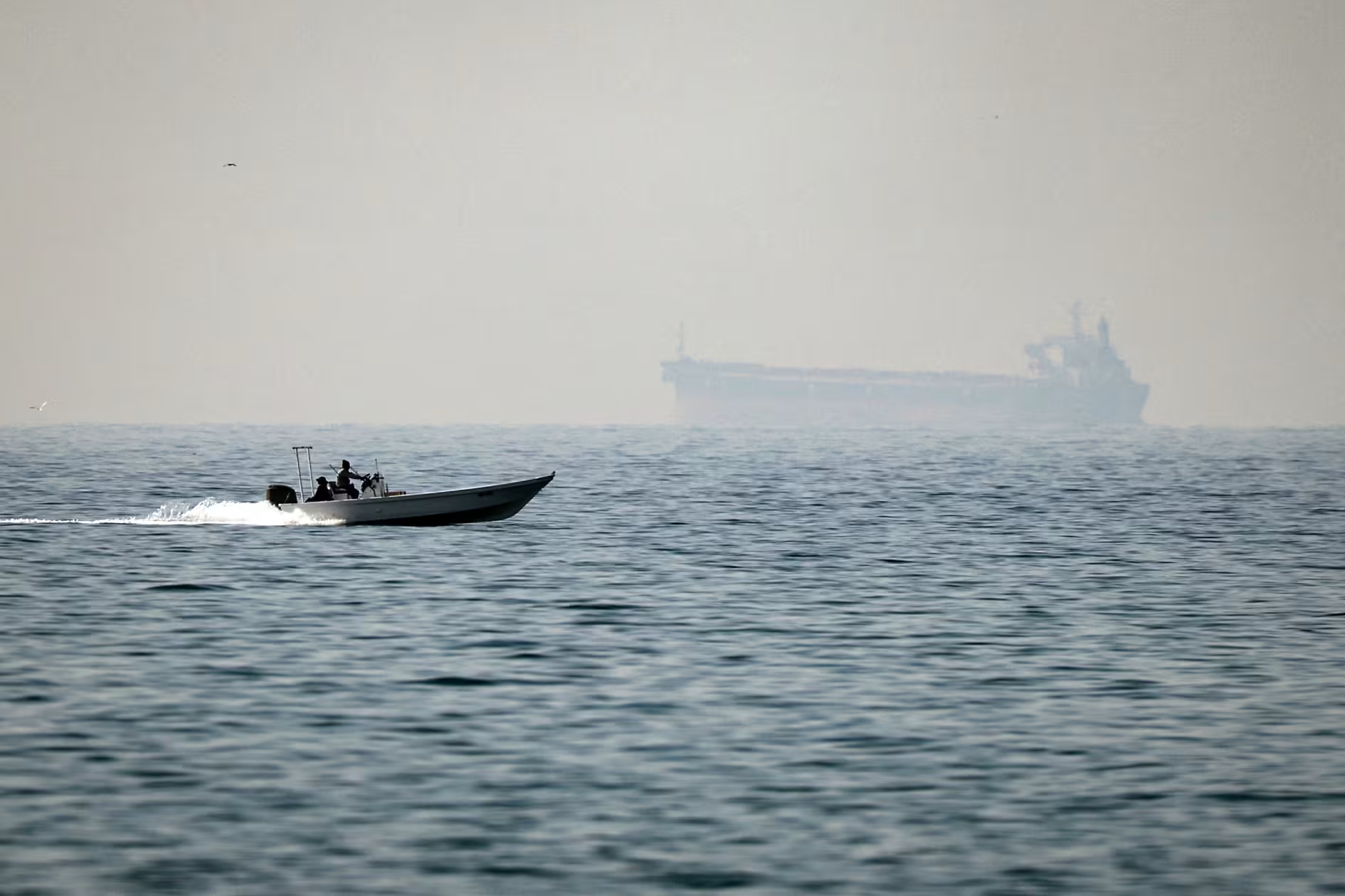
Whatever happens next, the impact on oil prices will largely depend on developments in the Strait of Hormuz—a vital energy chokepoint through which about 20% of global oil and liquefied natural gas trade passes, according to the U.S. Energy Information Administration.
Oil prices surged more than 7%
immediately after the market reopened Sunday evening in New York. Over the weekend, synthetic perpetual oil-futures trading on Hyperliquid, a decentralized crypto-based trading platform that is closed to U.S. investors, saw a big spike, as traders rushed to the 24/7 cryptocurrency market to register reactions to the latest conflict. Whether this will carry over into the global market for commodity futures remains to be seen.
If Iran moves to blockade the strait, crude prices could skyrocket, economists say. Bloomberg Economics has projected that if the Strait of Hormuz is blocked, oil prices could shoot to $108 a barrel. Others say the move could be even bigger. On Friday, U.S.-traded crude for April delivery settled at around $67 a barrel, Dow Jones Market Data showed.
Iranian government officials reportedly told Al Jazeera on Sunday that the country has no plan to close the strait. But a day earlier, a European Union official told Reuters that vessels crossing the strait had received high-frequency transmissions from the Iranian Revolutionary Guard Corps warning them not to attempt passage. The highest levels of the Iranian government would need to act in order to close the strait. That hasn’t happened — at least not yet.
Even so, energy-market analysts say there has been a notable drop in tanker traffic through the strait. As of late last week, 20 million barrels of crude oil flowed through the strait in a day. By early Saturday, that number appeared to have dropped to effectively zero, according to a chart from Rystad Energy.
Rystad Energy
President Donald Trump’s geopolitical playbook, according to Mizuho strategist Jordan Rochester, has so often gone something like this: first, a geopolitical shock, then an abrupt jump in oil prices, followed by immediate or nearly immediate de-escalation. The jump in prices, and any declines in risk assets like stocks, has, as the episode plays out, quickly reversed.
Whether that pattern holds this time will be critical to guiding the reaction in global markets over the coming days and weeks.
The fact that Iran has already launched retaliatory strikes not just against the U.S. and Israel but on assets situated in the United Arab Emirates, Saudi Arabia, Jordan and other Western allies in the region, suggests this conflict won’t be as quick to resolve as the one last June, said Jorge León, senior vice president and head of geopolitical analysis at Rystad Energy. The U.S. and Israel in June specifically targeted Iranian nuclear facilities, which Trump said at the time had been “completely and totally obliterated.”
In commentary shared with MarketWatch, León wrote that, this weekend, “Iran has retaliated in a far more aggressive and expansive manner than in prior exchanges, targeting US military bases in the region and even conducting attacks on its key Gulf allies.”
This fact, according to León, “marks a structural widening of the conflict beyond contained or symbolic strikes.”
The Strategic Importance of the Strait of Hormuz
Geographical Overview
The Strait of Hormuz is a narrow water passage located between Oman and the United Arab Emirates on one side and Iran on the other. It serves as the primary conduit for oil and other energy products, such as liquefied natural gas, flowing from the Persian Gulf to Asia, Africa, and beyond.
At its narrowest point, the strait is about 20 miles wide, with shipping lanes only 2 miles wide. This makes it highly vulnerable to mining and military blockades, which could significantly disrupt global energy supplies.
The map below of Iranian energy infrastructure, courtesy of Rystad Energy, shows the strait near the bottom-right corner.
Rystad Energy
Muyu Xu, an analyst at Kpler, a data intelligence and analytics platform, estimates that even a one-day blockage of the Strait of Hormuz could send crude oil prices soaring to $120–$150 per barrel.
In the past, Iran has shied away from trying to close the strait because such a move would be a blunt instrument that would hurt adversaries and allies alike, including China, a major buyer of Iranian oil, according to several analysts.
But now that the U.S. and Israel have killed the country’s supreme leader, Ayatollah Ali Khamenei, along with, reportedly, dozens of senior military commanders, the Iranian regime could decide that such a desperate measure might be its best shot at forcing the U.S. and Israel to back down.
Already, the strait has been effectively closed for the first time in modern history, said Jordan Rochester, a strategist at Mizuho Bank in London. Maritime insurers have pulled coverage, and several vessels attempting to transit through the strait have turned back.
Saudi Arabia and the UAE can reroute some of their crude oil supply through pipelines, but this will only compensate for about one-third of the loss of shipments through the strait, according to Rystad’s León.
“Whether the Strait of Hormuz is closed by force or rendered inaccessible by risk avoidance, the impact on global oil flows is largely the same,” León said.
—
Potential Global Economic Impact
– Surge in crude oil and natural gas prices
– Increased inflationary pressure worldwide
– Risk of economic slowdown in oil-importing countries
– Heightened geopolitical tensions in the Middle East
Conclusion
The ongoing Iran conflict has placed the Strait of Hormuz—one of the world’s most critical energy chokepoints—at the center of global attention. Any disruption here could trigger a sharp rise in oil prices, impact global markets, and strain the world economy. Governments and businesses worldwide are closely monitoring the developments, ready to respond to any escalation in this vital region.



