
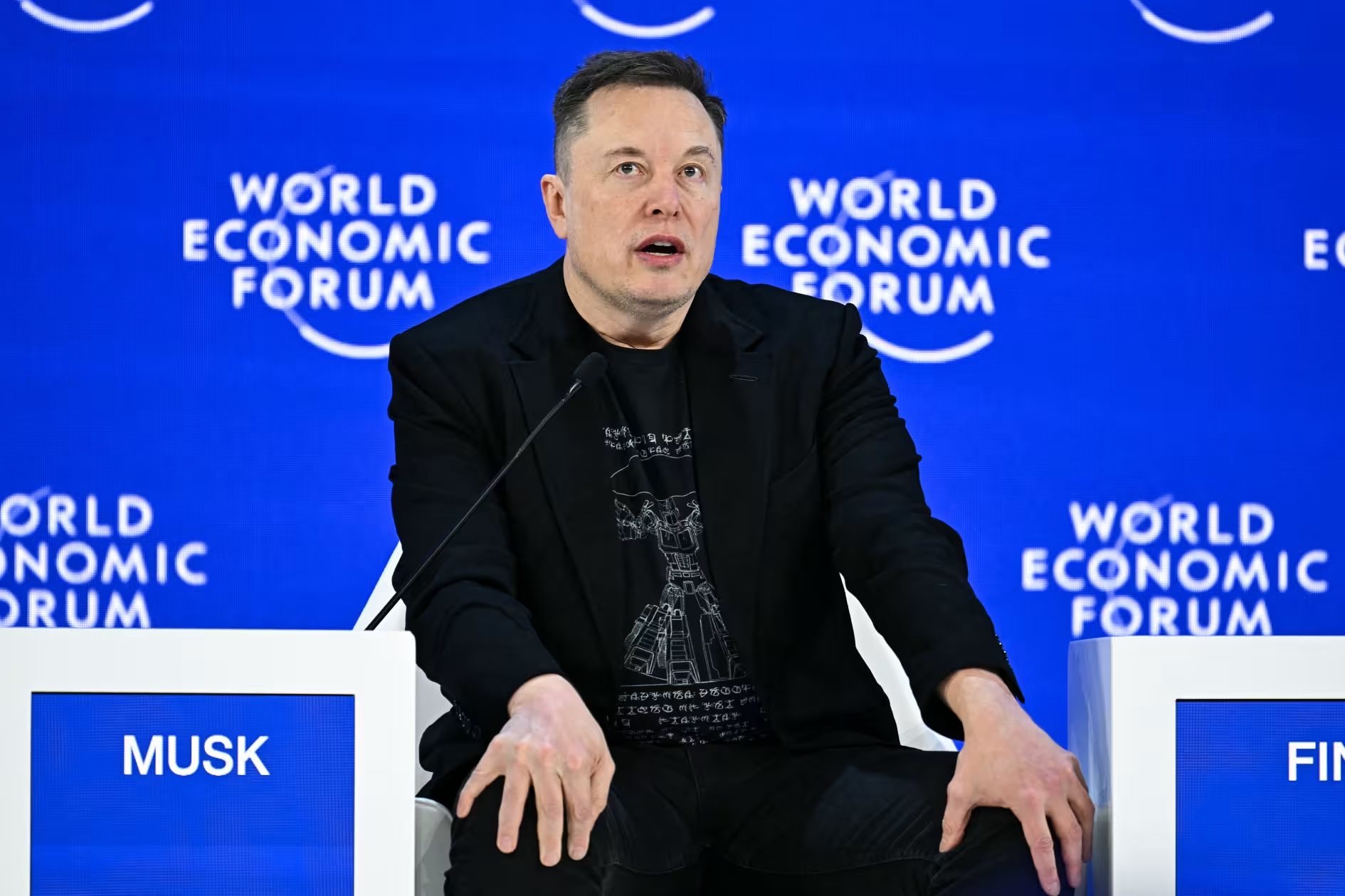
Elon Musk has revealed a bold strategy to produce chips for his own businesses.
This year, semiconductor-equipment companies have been popular artificial intelligence investments, and another catalyst may be on the horizon.
According to analysts, one of the largest possible gains from Elon Musk’s grandiose goal to produce his own chips are shares of chip-equipment manufacturers. SpaceX and Tesla (TSLA) will need to invest enormous sums of money to realize Musk’s goal. The main question at hand is the viability of Musk’s endeavor.
In an effort to scale up to 1 terawatt of computing power annually, Musk revealed on Saturday that he intends to construct a “Terafab” facility in Austin, Texas, which will make chips for Tesla automobiles and robotics as well as space-based data centers. Everything required for sophisticated chips, including logic and memory components and packaging methods, is anticipated to be produced at the fabrication facility.
See more: This year has seen a surge in these “safer” tech stocks. Is buying in too late?
Jordan Klein, a trading desk analyst at Mizuho, believes that ASML Holding (ASML), a Dutch producer of semiconductor equipment, would be a major benefactor of both Musk’s overall ambition to increase chip production and the Terafab project. Klein stated in a note on Monday that the Terafab would require ASML’s extreme-ultraviolet lithography machines in order to manufacture chips larger than the 2-nanometer process since it would be producing cutting-edge chips.
According to him, KLA (KLAC), a manufacturer of wafer-fab equipment, might also profit from Terafab’s efforts because it provides sophisticated metrology systems for design verification and high-volume chip manufacturing process monitoring.
Equipment for the production and packaging procedures of etching and deposition would also likely be required for the business. According to Klein, that would benefit Applied Materials (AMAT), Lam Research (LRCX), TE Connectivity (TEL), and perhaps Teradyne (TER).
According to Musk, one terawatt of computation is around 50 times the 20 gigawatts of current world compute supply. According to Bernstein analyst Stacy Rasgon’s “very rough back-of-the-envelope” calculations, capital expenditures on wafers for various chip types, including high-bandwidth memory, could range from $5 trillion to $13 trillion.
According to Klein, there are still concerns about the Terafab’s finance and schedule. He pointed out that the construction of the fab’s shell alone might take two to three years.
However, Klein advised investors to hold off on becoming overly enthusiastic about possible project winners until additional Terafab specifics are finalized and made public.
In the next three years and beyond, he sees the Terafab as “another potential call option for upside to [wafer-fab equipment]”. So far this year, a number of more general chip-equipment firms have made significant gains. For example, Teradyne’s 57% increase in the PHLX Semiconductor Index SOX ranks top, while Applied Materials’ 41% gain ranks fourth.
Similar to Klein, Bernstein’s Rasgon stated in a note on Monday that the Terafab announcement doesn’t yet imply “all that much beyond the hype.” But for Musk supporters, “you would want to buy semicap,” he stated.
Incumbent chip manufacturers may view Musk’s plan to manufacture his own chips negatively, he continued, but “in a world where compute is this strong, any player is going to see far more upside than they could ever handle.”



