🔴
Trending
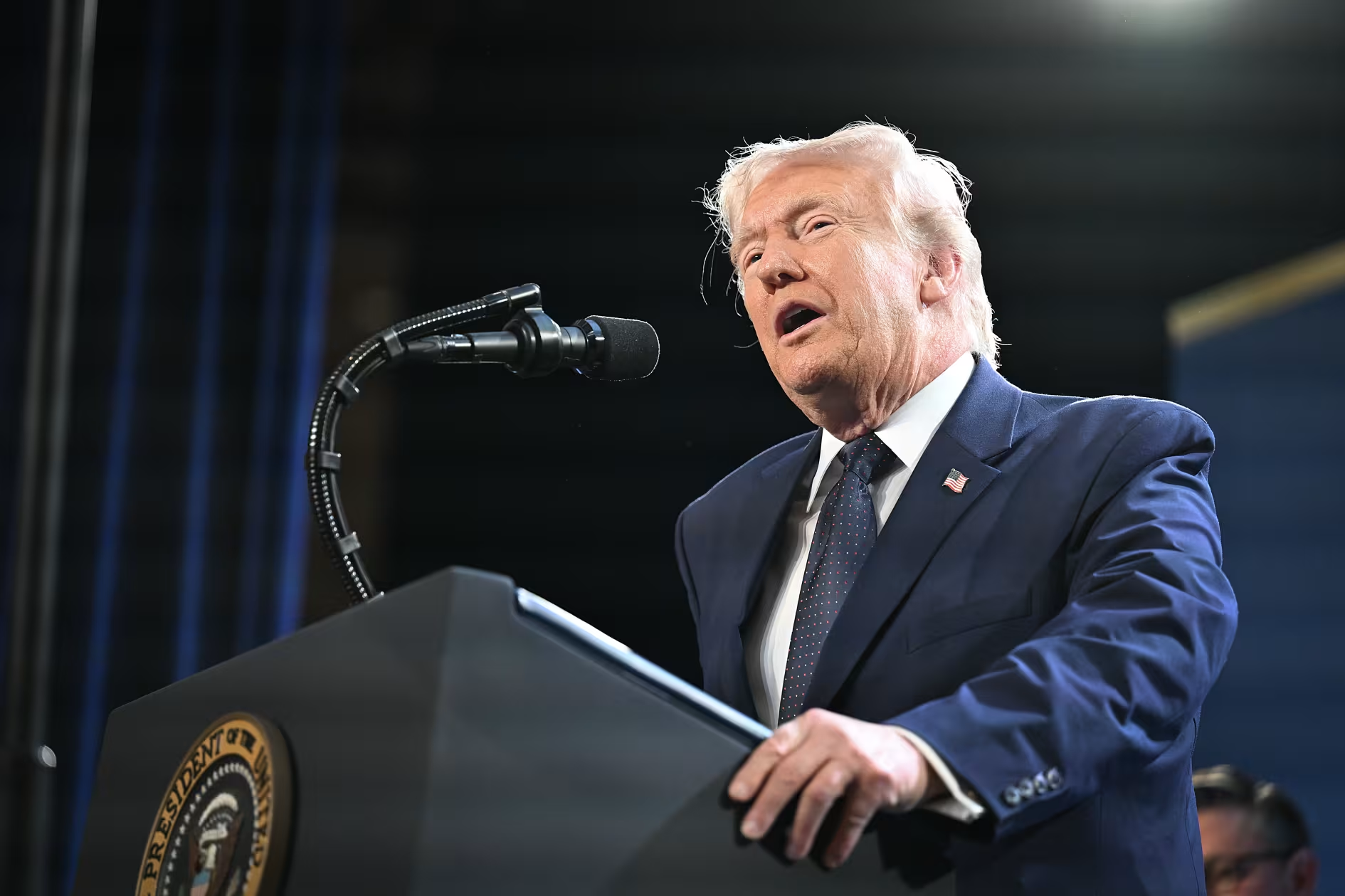
- Trump predicts the Iran war will finish “very soon” and announces the lifting of sanctions to lower oil prices.
- We’ve learned from 50 years of oil price shocks that there are currently just two factors that matter to markets.
- Big Tech stocks are steadily rising, but don’t anticipate a sustained surge.
- YouTube is currently the biggest media corporation in the world, and it continues to grow.
- These five stocks may rise in response to Nvidia’s major GTC event.
- The situation in Iran is unlikely to harm the US economy or increase inflation, but the Fed will take its time lowering interest rates.
- Strait of Hormuz Crisis: Oil Prices & Global Impact
- Iran Conflict Drives U.S. Gas Prices Higher in Spring 2026

Author: starbpo

The numbers: The U.S. economy grew at a slow 1.3% annual rate in the first three months of the year, according to updated data. This was mostly due to lower consumer spending, which could mean that the economy as a whole will slow down. Gross domestic product, which is the economy’s official scorecard, rose by the least amount in almost two years. The government said earlier that GDP grew at a rate of 1.6% in the first quarter. The weak GDP report was mostly caused by a bigger trade deficit and less production of goods that haven’t been sold yet.…
The amounts: The advanced estimate from the Commerce Department released Thursday shows that the U.S. trade deficit in goods grew by 7.7% to $99.4 billion in April. Since May 2022, that’s the biggest deficit ever. A poll of economists by Econoday found that most of them thought the deficit would grow to $92.5 billion. The report also showed that wholesale inventories went up by 0.2% in April, after going down by 0.4% the previous month. And retail inventories that were already out there went up 0.7%, after going up 0.1% in March. If you take out cars, retail inventories went…
Is the economy getting worse? It doesn’t look like that, at least based on what we know about this week’s economic data. The Wall Street Journal polled economists and found that most of them think the job market will grow in a healthy way. It is also expected that the service sector will get better. But Scott Anderson, who is the chief U.S. economist at BMO Capital Markets, is worried that the U.S. economy is losing some of its air. A lot of “downbeat data” came out last week, he told his clients. This included a lower estimate for GDP…
The Senate is expected to intensify its work on the tax and spending megabill that was approved by the House of Representatives prior to the week-long vacation as Congress returns to Washington. According to House Speaker Mike Johnson, Senate Republicans should “make as few modifications as possible, remembering that I have a very delicate balance on our very diverse Republican caucus over in the House.” The megabill was finally approved on May 22 by a narrow margin of 215 to 214 in the House, where the GOP holds a 220-212 majority. Additionally, President Donald Trump and his advisers are advocating…
A separate bill focusing on the cryptocurrency business this week gives a bipartisan bill on credit-card swipe fees, which has been dormant for years, another chance to pass the U.S. Senate. Later this week, there is a possibility that the Credit Card Competition Act, which aims to provide retailers more options when using credit-card networks, will be added as an addition to the Genius Act, a bill that aims to regulate and strengthen stablecoins. One kind of cryptocurrency whose value is tied to another asset, such as the dollar, is called a stablecoin. According to a group of Washington policy…
According to a recent research by analysts at Wolfe Research, some trades made by U.S. lawmakers tend to have predictive potential, even if the average member of Congress isn’t a superstar trader and could be better served sticking to index funds. According to the analysts’ research dated Tuesday, “certain conditions – like who is in power, how quickly a trade is disclosed, or how large a trade is – significantly affect whether a given transaction has predictive power,” says the team led by Yin Luo and David Elledge. Following positive remarks from influential figures in Washington, D.C., the revelation comes…
Economists at Goldman Sachs have delayed their prediction for the first Federal Reserve interest rate cut from July to September. They noted that recent speeches by Fed officials indicate that a July cut would require not only improved inflation figures but also significant signs of a slowdown in economic activity or the labor market. Data released on Thursday showed lower weekly jobless claims and stronger purchasing managers indexes, suggesting that a July cut is unlikely. Following the data release, U.S. stocks dropped on Thursday, with the Dow Jones Industrial Average experiencing its largest decline in over a year, while bond…
The softer economic growth in the first quarter indicates the economy is slowing down, which is affecting corporate profits, according to the Commerce Department on Thursday. Corporate profits fell by 0.6% in the first quarter after a 4.1% increase in the previous three months, marking the first decline in a year. “A margin of slack capacity is opening up and consumers are feeling less flush. That showed up in a drop in corporate profits,” said Bill Adams, chief economist for Comerica Bank in Dallas. “A cooler economy is limiting businesses’ ability to raise prices, which will help slow inflation in…
Mortgage rates experienced their largest jump in over a month, pushing the 30-year rate above 7%, amid uncertainty about when the Federal Reserve will reduce interest rates. As of May 30, the 30-year fixed-rate mortgage averaged 7.03%, according to Freddie Mac’s data released on Thursday, marking a 9 basis point increase from the previous week. A basis point is one-hundredth of a percentage point. A year ago, the 30-year rate was 6.79%. The 15-year mortgage rate averaged 6.36%, up from 6.24% last week and 6.18% a year ago. Freddie Mac’s weekly mortgage rate report is based on thousands of applications…
The Chicago Business Barometer, or Chicago PMI, dropped to 35.4 in May from 37.9 in April, marking its lowest point since May 2020 during the pandemic. This figure was much lower than expected, as economists surveyed by the Wall Street Journal had predicted a reading of 40.8. This marks the sixth consecutive month the index has been in contraction. The index, produced by ISM-Chicago and MNI, is made available to subscribers three minutes before its public release at 9:45 am Eastern. It is one of the final regional manufacturing indices released before the key national ISM manufacturing survey for May,…