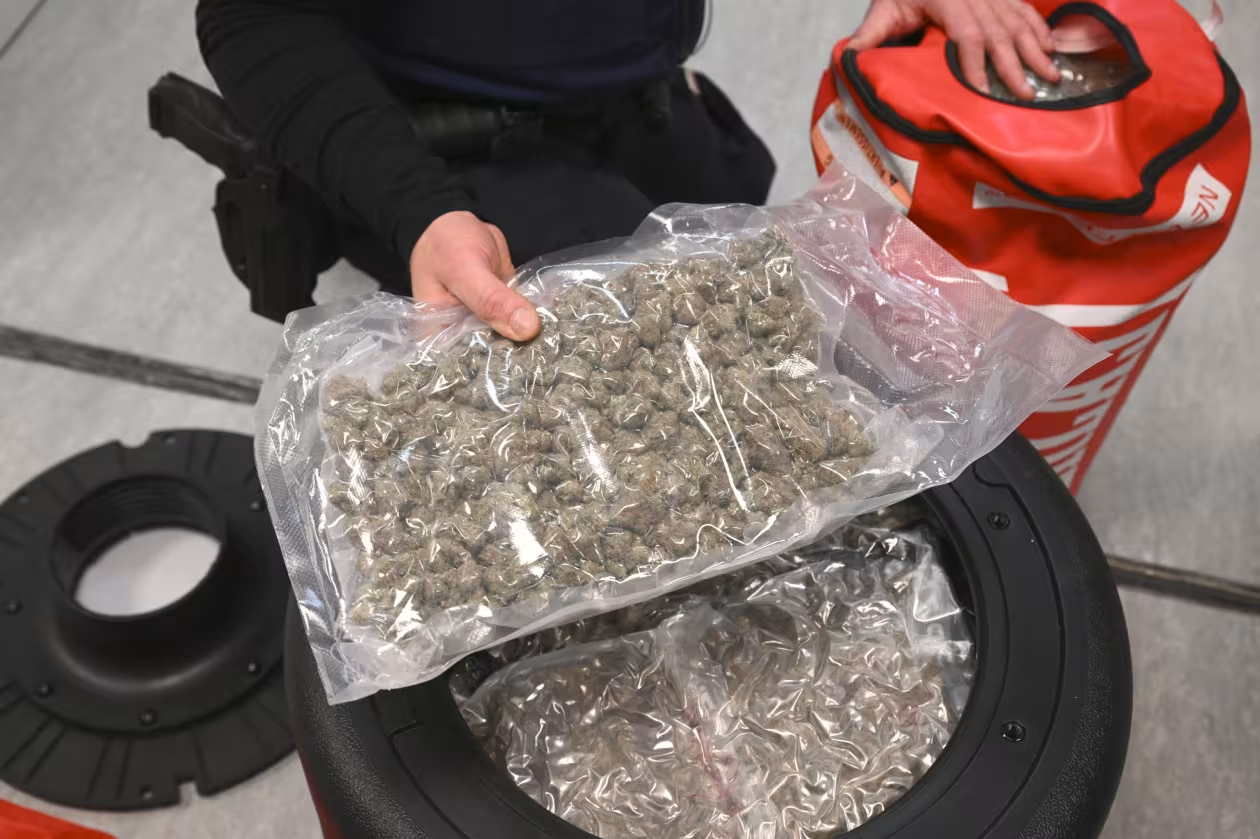
A proposal to reschedule cannabis in the United States was approved by President Donald Trump.
Although shares of American and Canadian cannabis companies fell on the news, President Donald Trump signed an executive order on Thursday requesting that the U.S. government reschedule cannabis. This is the most major federal change on the drug in decades.
According to Trump administration officials, the action, which does not legalize marijuana and has no set date, is meant to facilitate study into possible medical applications.
In the meanwhile, industry leaders said that the reclassification will reduce tax costs that have stifled revenues by placing cannabis in the same drug category as items like Tylenol with codeine.
Additionally, Trump stated that he is requesting that Congress reevaluate the classification of CBD derived from hemp so that seniors can obtain it. Additionally, Centers for Medicare & Medicaid Services director Dr. Mehmet Oz stated that he would allow the government to authorize CBD for Medicare patients “as early as April of next year, and at no charge if their doctors recommend.”
“This action has been requested by American patients suffering from extreme pain, incurable diseases, aggressive cancers, seizure disorders, neurological problems and more, including numerous veterans with service-related injuries and older Americans who live with chronic medical problems that severely degrade their quality of life,” Trump stated at a White House ceremony to mark the order’s signing.
In addition to substances like heroin and LSD, the executive order would instruct the attorney general to expedite the process of moving cannabis from Schedule I to Schedule III. According to the directive, the attorney general must implement those modifications “in the most expeditious manner in accordance with federal law.”
“It is critical to close the gap between current medical marijuana and CBD use and medical knowledge of risks and benefits, including for specific populations and conditions,” the court decision stated.
Following the announcement, cannabis stocks fell on Thursday as investors probably moved to cash in on their earlier optimism over Trump’s executive order.
On Thursday, the AdvisorShares Pure U.S. Cannabis exchange-traded fund MSOS ended the day 26.8% down. Rival Trulieve Cannabis (CA:TRUL) saw a 21.2% decline in share price, while Curaleaf Holdings (CURLF), a cannabis manufacturer with operations in several U.S. states, saw a 33.4% decline.
Tilray Brands (TLRY) saw a 4.2% decline among Canadian names. Canopy Growth’s (CGC) (CA:WEED) stock dropped 12%.
Last week, preliminary reports that Trump was attempting to reclassify marijuana caused stocks in the industry to soar. A day after Trump stated he was “very strongly” considering rescheduling, the markets increased even more on Tuesday.
Trump’s main objective with his rescheduling order, according to senior Trump administration officials who spoke to reporters on Thursday, is to increase research into medical marijuana and cannabidiol products so that physicians and patients are better informed. The cannabis plant contains a substance called cannabidiol, or CBD.
The officials stated that the administration’s actions did not support the use of cannabis by teenagers or as a recreational drug, but that the president had heard from numerous individuals who emphasized the potential advantages of medical marijuana and CBD use. The order did not provide a timeframe for rescheduling, but officials stated that it should be completed as quickly as feasible.
Trump declared his support for a Florida ballot issue that would have permitted legal recreational cannabis usage in his home state during the 2024 presidential campaign. He also pledged to concentrate on rescheduling the drug as president.
When questioned on Thursday about whether Trump will advocate for the complete legalization of marijuana for recreational use, administration representatives stated they would not make any assumptions about the president’s future plans.
Trump cited positive polls on the subject when questioned about the rescheduling concerns of his fellow Republicans. Additionally, he stated that those who are “through this horrible ordeal of cancer or other things” have come to understand that “this is something that makes them feel better.”
Nevertheless, 22 Republican senators opposed rescheduling in a letter to the president on Wednesday. A similar letter was sent Thursday by 26 Republicans in the House.
“Reclassifying marijuana as a Schedule III drug will enable drug cartels, send the wrong message to America’s children, and make our roads more dangerous,” the House lawmakers said in an opinion piece. The senators argued that “facilitating the growth of the marijuana industry is at odds with growing our economy and encouraging healthy lifestyles for Americans.”
Cannabis business insiders, however, praised Thursday’s announcement.
“By removing those barriers, it’s really going to enable scientists and health care providers to further explore the therapeutic potential of medical marijuana – both on the benefit side, but also on the risk side, which is critical if we’re going to advance this industry in a meaningful way,” Kim Rivers, the chief executive of Trulieve, said.
For example, the company wanted to collaborate more closely with its research partners on a time-release medicine that patients could take after the reclassification was final, according to Rivers, who said she was present at the signing of the order and that she had spoken with Trump about rescheduling.
“We have not had a way to be able to do blood tests, for example, to be able to prove efficacy of that product,” she stated.
Due to overexpansion or regulations, the cannabis sector has struggled to make a consistent profit over time in both the United States and Canada. Despite Canada’s legalization of marijuana for recreational use in 2018, some major producers are still struggling to recover from their losses.
Rescheduling, according to economists, might lessen the burden of the 280E tax in the United States, which essentially levies profits without letting companies deduct certain expenses.
Trump’s directive to reschedule cannabis came during “the most margin-compressed period the legal cannabis industry has ever seen,” according to an analysis from industry tracker Headset that examined retail data from 24 states. According to that report, U.S. cannabis gross margins have decreased by about 10 percentage points since 2021.
“Because of Section 280E, cannabis businesses have faced effective tax rates of roughly 70 to 90 percent,” wrote Charles Alovisetti, a partner at Vicente Law Firm, in an email. “Rescheduling eliminates that burden, bringing tax rates closer to the roughly 20 percent range seen in other industries.”