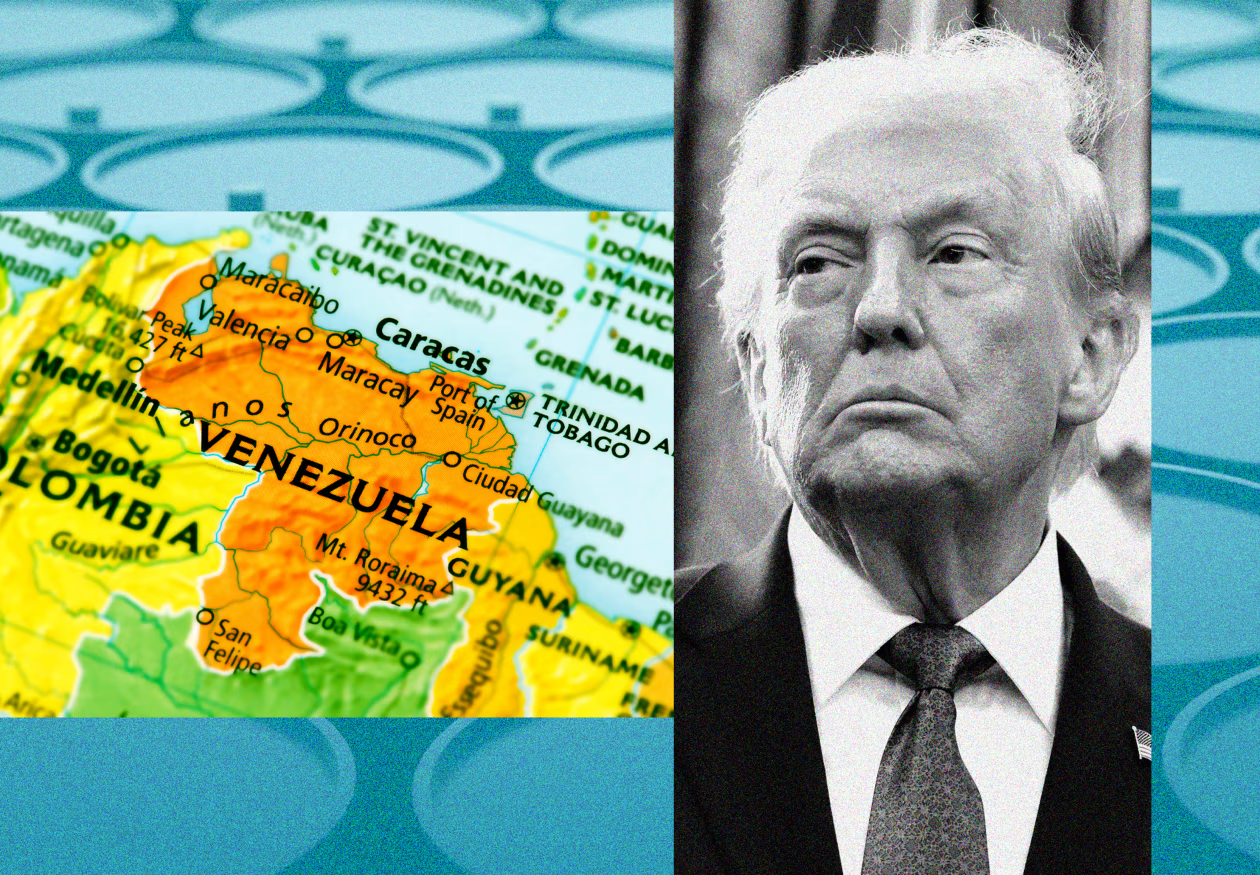
Less than a week after the United States apprehended Venezuelan leader Nicolás Maduro, President Trump is scheduled to meet with oil executives.
Tens of billions of dollars in new U.S. energy investment in the South American nation could be made possible by President Donald Trump’s meeting with senior executives of oil companies on Friday, but there are still a lot of outstanding concerns.
Less than a week has passed since the United States seized Venezuelan President Nicolás Maduro, when Trump is scheduled to meet with him. It is anticipated that executives from ConocoPhillips (COP), Chevron (CVX), Exxon Mobil (XOM), and other companies would be present.
According to Simon Lack, portfolio manager of the Catalyst Energy Infrastructure Fund MLXIX, Trump will want American oil corporations to pledge to invest billions of dollars in Venezuela to increase oil output. “They’ll search for easy ways to increase output. Since [Chevron] currently operates there, they are likely in the strongest position, albeit it is unclear how realistic this is.
What the oil firms want from the administration and what the White House can provide in terms of financial and physical security guarantees will be another important topic of discussion. Requests for response from Exxon Mobil, Chevron, and ConocoPhillips were not immediately answered.
According to White House press secretary Karoline Leavitt, the purpose of the meeting is to talk about “the immense opportunity that is before these oil companies right now,” she told reporters on Wednesday. In response to a question on whether the United States would guarantee the safety of its employees in Venezuela, Leavitt stated that “the president is going to do what’s in the best interest of the American people, and that includes workers from our energy and oil industry.”
According to Manish Raj, managing director at Velandera Energy Partners, “Oil companies like Chevron, ExxonMobil, and ConocoPhillips are burned once, twice shy, given they lost billions when Venezuela nationalized their prior investments.”
These majors would therefore consider the “durability of Venezuela’s promises beyond Trump’s term ending in 2028,” Raj continued. Any pledge made by Venezuela or the United States, however, is “subject to reneging by subsequent administrations.”
According to Lack, the issue is that the oil corporations “will be looking much further out than the remainder of Trump’s term.” Trump might give security assurances and a portion of the proceeds from oil sales.
According to Brian Kessens, a fund manager at Tortoise Capital, the United States may also provide the corporations with some tax breaks.
Trump said late Tuesday that Venezuela will deliver 30 to 50 million barrels of oil to the United States, which the United States would then sell. He stated that Trump himself will be in charge of the earnings.
“The biggest beneficiaries of transfer of oil from Venezuela to the U.S. will be existing creditors and hedge funds who have bought the distressed assets,” Raj stated to BourseWatch. “The first proceeds from any oil sales will likely be used to pay off Venezuela’s debt to oil companies – with the largest amount being owed to ConocoPhillips, and Italy’s Eni (E) and ExxonMobil.” Then, he pointed out, there are bondholders due more than $60 billion.
There is currently uncertainty on the specifics and timetable of such a scheme to import Venezuelan oil into the United States. U.S. Energy Secretary Chris Wright stated on Wednesday that the United States is prepared to get Venezuela’s crude “moving again and sell it.” Wright also stated that he is working directly with Venezuela in cooperation.
Wright stated at a Goldman Sachs energy conference, “As we make progress with the government, we’ll enable the importing of parts and equipment and services to kind of prevent the industry from collapsing [and] stabilize the production.”
He added that another long-term objective is to “create the conditions” that would allow big American businesses to enter the oil-rich country.
In general, Raj thinks “it will be years before Venezuela sees a penny from oil sales and its past-due amounts are repaid.”
nevertheless, “if oil majors go in, they get access to the biggest untapped oil lands,” he stated. This ends up being “an opportunity for Big Oil titans to reclaim their lost stakes – proving that in energy geopolitics, fortune favors the bold invaders.”
As Exxon and ConocoPhillips left Venezuela during waves of asset seizures and expropriations that began in the 2000s under then-President Hugo Chávez and continued under Maduro, Chevron retained a now-coveted presence in the country.
According to Trump, American oil firms would compensate themselves for the billions of dollars they directly pay to restore Venezuela’s oil infrastructure. According to a White House spokeswoman earlier this week, “all of our oil companies are ready and willing to make big investments in Venezuela.”
At around 300 billion barrels per day, Venezuela claims to have the greatest proven petroleum reserves in the world, but there has been significant doubt about that self-reported figure. The reserves increased in the late 2000s as the Chávez administration reclassified some of the nation’s most difficult-to-refine and heavy oil as proven.
Approximately one-fifth of Venezuela’s crude production, or one million barrels per day, is produced by Chevron, which theoretically would have the most straightforward route after years of difficulties for the country’s oil sector.
According to a recent note by analysts at Rystad Energy, over $53 billion in infrastructure and upstream oil and gas investments would be required over the next 15 years “just to keep Venezuela’s crude oil production flat” at 1.1 million barrels per day.