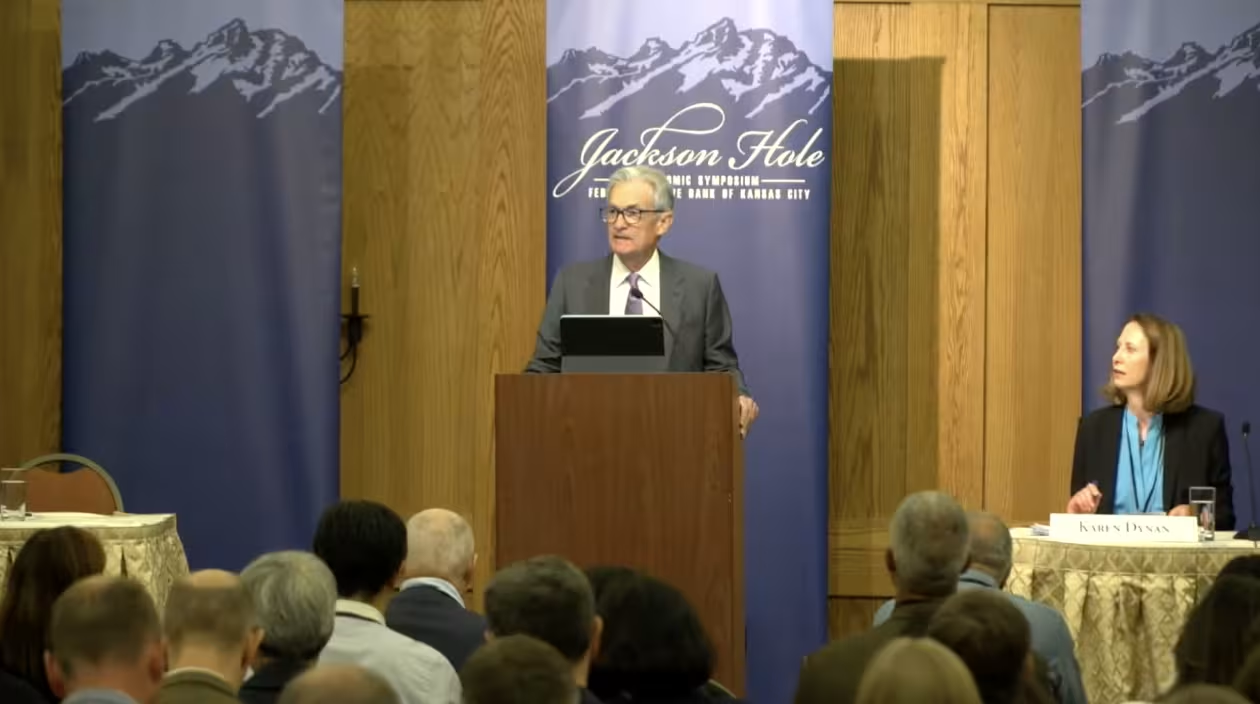
Fed Chair Jerome Powell might not be as enthusiastic about rate cuts as the White House.
Traders remain overly confident about the pace and scope of the Fed’s lowering agenda, even if bond markets have tempered expectations for a fifty basis point rate decrease in September following alarming PPI data last week. “The assumption that the last employment report all but guarantees a September rate cut has driven market pricing… and if that assumption is wrong, pricing may suffer a harsh reversal.”
Tim Duy, the head economist at SGH Macro Advisors and a seasoned Fed observer, believes that. Despite Powell’s lack of guarantee that there will be more, a new research note released on Monday foresees “a messy compromise insurance cut” next month. In order to add uncertainty to fixed-income markets that are pricing in three cuts this year and 100 basis points in the following 12 months, Duy anticipates Powell to base policy on forthcoming data.
Duy says that “September is not a lock but still up in the air, dependent on the next round of data, which will be extremely frustrating for market participants.”
Both decreasing labor force growth and sticky inflation statistics support Duy’s conclusion that Fed dove confidence may be misplaced.
Duy points out that retail sales data shows that consumers are still resilient, but he believes that inflation could be the most obstacle to rate decreases. According to the Philadelphia Fed’s survey of professional forecasters, the median inflation projection for the fourth quarter of 2025 is now a 3% annual increase, as Duy notes. The core personal consumption expenditure price index, the Fed’s favored indicator of inflation, is predicted to reach 3.1% in the fourth quarter, which is once more significantly above than the Fed’s stated 2% target.
Expectations for medium-term inflation
Furthermore, the fourth-quarter unemployment rate is predicted by median forecasters to be 4.4%, which is lower than the June estimate. Duy argues that “breakeven job growth may even have collapsed to nearly zero with immigration slowing to a crawl.” The implications of slower payroll growth must be reconsidered in light of the shifting labor market dynamics. Alberto Musalem, president of the Federal Reserve in St. Louis, pointed out that a negative payroll print may not always indicate that labor market conditions are improving.
The forecast for the rate-cutting cycle is therefore complicated by the Fed’s dual mandate, which makes some board members hesitant. For this reason, Duy predicts only two cutbacks this year, which will be made in September and December.
Since June, the outlook for the Fed’s dual mission has been worse on both fronts.
Powell will give a set-piece address at the Jackson Hole Economic Policy Symposium this week, where Duy anticipates that he would defend the Fed’s independence and use cautious language regarding monetary policy, emphasizing terms like “measured” and “gradual.”
As U.S. stock market futures (ES00) indicated a softer opening on Wall Street, the yield on the 2-year Treasury BX:TMUBMUSD02Y, which is highly impacted by Fed rate forecasts, fell 2 basis points on Monday.