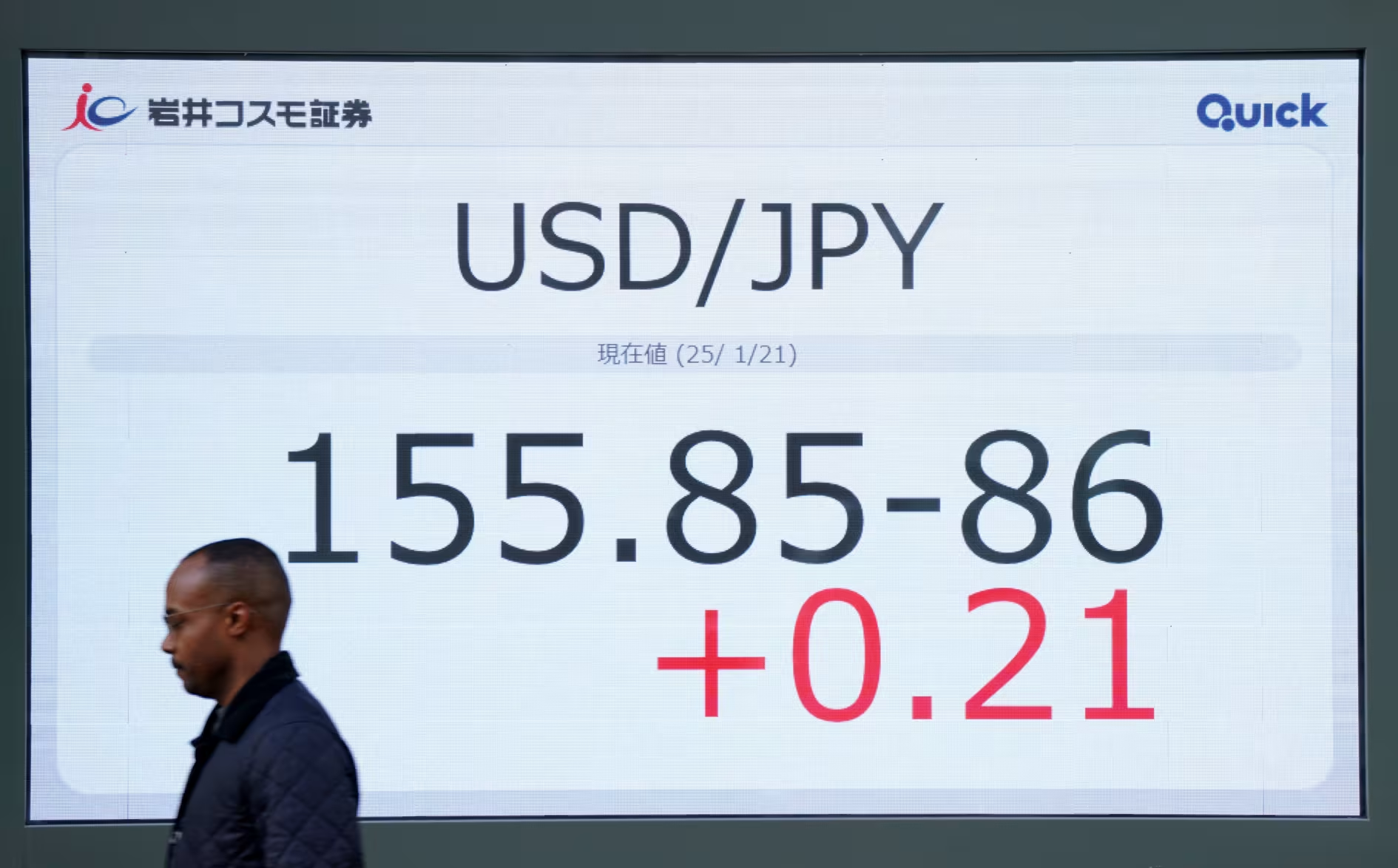
On Friday afternoon, the yen appreciated vs the dollar.
Although Friday was a mostly calm day for markets, one significant event that caused some concern was the rapid collapse of the US dollar versus the Japanese yen late in the morning in New York.
The dollar’s decline versus the euro (EURUSD), British pound (GBPUSD), Swiss franc (USDCHF), and other competitors swiftly spread to other currency pairs. The dollar was down 1.7% at 155.71 yen (USDJPY), its lowest level in about a month, according to FactSet data, and the slide continued throughout the afternoon. The dollar had been trading at its highest level against the yen for the previous eighteen months.
According to the performance of the ICE U.S. Dollar Index DXY, which measures the value of the dollar against a basket of competitors, it ended the dollar’s worst week in eight months.
Some saw the action as having the traditional characteristics of Bank of Japan intervention. In a post on X, Joseph Brusuelas, chief economist at RSM U.S., stated that it appeared as though the Bank of Japan was interfering in the currency market to strengthen the yen.
Others said that the Federal Reserve’s “rate checks”—that is, contacting major currency dealers and requesting quotes on the dollar-yen pair—were the reason behind the action.
In a remark shared with customers and MarketWatch, Brent Donnelly, president of Spectra Markets, stated that news had spread that the Federal Reserve had contacted big currency dealers and requested dollar-yen rate checks. According to Donnelly, this is probably what led to the dollar’s sell-off shortly after 11 a.m. Eastern time.
“A lot of confusion as to what was going on, but it eventually became clear that the Fed did a rate check and this was public information that banks were allowed to share,” he stated.
Regarding potential future developments, Donnelly pointed out that there are other ways to understand the central bank’s goals in this situation. According to Donnelly, the U.S. central bank complied with Japan’s Ministry of Finance’s request for the U.S. Treasury Department to request a rate check from the Federal Reserve. Central banks occasionally employ rate checks as a tool to initiate desired changes in exchange rates, according to currency-market specialists.
According to Donnelly, there are a few options worth taking into account if that was the case. First, without taking direct action, the Ministry of Finance wants to stabilize the yen. Government bond yields and currencies tend to move in tandem, and the Japanese yen has been declining over the past few months despite an increase in Japanese bond yields. Donnelly predicts that investors will soon witness a significant short squeeze in the currency pair if Japanese officials do nothing. At about 159 or 160 yen to the dollar, the Bank of Japan and the Ministry of Finance will then have to step in immediately.
MarketWatch has requested comments from the Federal Reserve, Treasury Department, and Bank of Japan.
A second possibility is that the Japanese Ministry of Finance will “drop the hammer” and try to drive the yen considerably higher on Sunday night, marking the beginning of additional intervention.
A third possibility is that Japanese authorities will hold off on using their weapons until Monday. The Bank of Japan indicated that more rate hikes would probably come after deciding to keep its benchmark interest rate steady on Friday.
In a written commentary, Donnelly stated, “For some reason, the previous Japanese administration loved selling [dollars for yen] in [New York] time.”
Another aspect to think about is that the action might be the beginning of more coordinated action between the United States and its Asian allies, such as South Korea and Japan. Recently, Treasury Secretary Scott Bessent stated that he spoke with a senior South Korean official about the weakness of the Korean won (USDKRW).
“I am always a massive skeptic of stories like this because they pop up frequently and they are never true,” said Donnelly. However, the Fed would not be acting in this manner if certain real-world judgments weren’t being taken. Therefore, it’s not absurd to think that the United States and other Asian allies have decided to stabilize or strengthen [the yen, the won, and the Taiwan dollar] in response to Bessent’s remarks on [the won] last week.