As tensions in the Middle East continue to unnerve investors, a relief rally in tech companies may help protect the overall market from additional declines.
The 2026 script has been reversed.
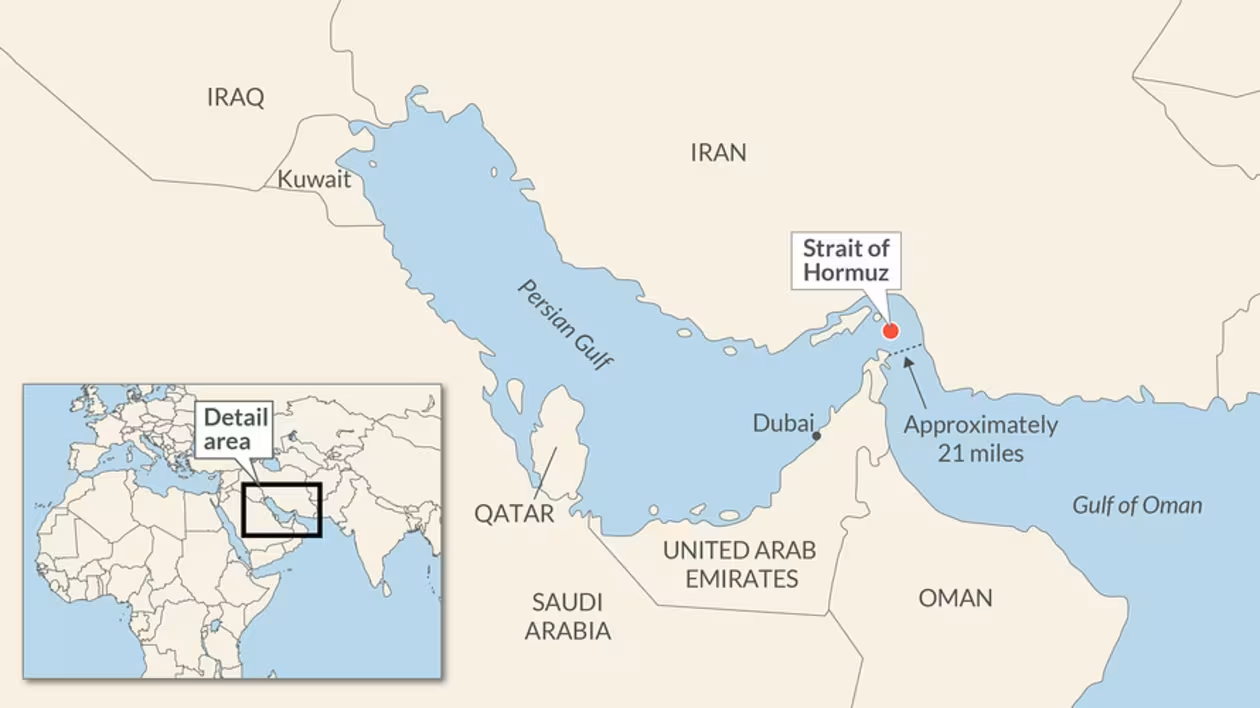
The increasing situation in Iran has suddenly caused investors to return to the familiar after months of switching to tiny caps and value stocks. Megacap technology names are back in the spotlight as oil prices (CL.1) (BRN00) momentarily surpass $100 per barrel; however, this time, they are seen as a port in the storm during an increasingly turbulent time for global markets rather than as growth leaders.
Last week saw software stocks and several members of the so-called Magnificent Seven group of tech names, including Microsoft Corp. (MSFT), surge, helping to offset volatility elsewhere in the market as the rotation trade that had defined U.S. equities in early 2026 crashed into reverse.
Last week, the iShares Expanded Tech-Software Sector ETF IGV saw its biggest weekly gain since April 25, 2025, rising 7.9%. According to FactSet data, the S&P 500’s information-technology sector XX:SP500.45 suffered slight losses, but it still outperformed the overall market as the second-best performance on the large-cap benchmark index. Energy companies, which typically profit from rising energy and natural gas costs, were the best performers.
According to FactSet statistics, the information-technology sector was the top performer on the S&P 500 on Monday, up 1.8%, while the large-cap index SPX increased a modest 0.8%, suggesting that this trend is continuing this week. According to FactSet, the Dow Jones Industrial Average DJIA finished up 0.5%, while the tech-heavy Nasdaq composite COMP surged 1.4%.The relative strength of the tech sector was one feature of last week’s market activity that might be worth keeping an eye on this week. Chris Larkin, managing director of trading and investing at E*Trade from Morgan Stanley, stated that if it continues this week, it might have a stabilizing effect on the overall market.
Technical indicators also suggest that IGV, which ended Monday afternoon at $87.71, will continue to rise, supporting the short-term strength of software equities. According to Jonathan Krinsky, chief market technician at BTIG, the chart below indicates that IGV has maintained “a long-term support level,” thus there is potential for it to return to the $95–$100 region.
In fact, as investors continue to be alarmed by the tensions in the Middle East, a relief rally in IT stocks, particularly software names, could help protect the whole market from further declines. However, according to Jay Woods, chief market analyst at Freedom Capital Markets, the software industry is still dealing with disruption concerns from quickly developing artificial intelligence, so the recovery might not be robust enough to propel stocks to new highs.We’re going to see a change into some of those larger tech names now that these growth names have become value names, but it won’t be one of these shifts where we burst out to new highs,” Woods told MarketWatch over the phone on Monday. “”The AI disruption is still the story to focus on, but it will only stabilize the market,” he stated.
According to Woods, several of those tech stocks may also be appealing during volatile trading periods due to their lower values.
More software revenue is on the horizon.
Investors should keep an eye on pronouncements from the Trump administration and the G-7 meetings regarding the possible emergency release of oil reserves in addition to Middle East developments. This week will also see the release of earnings from two significant software companies.
Adobe (ADBE) will report its quarterly earnings on Thursday after the closing bell, and Oracle (ORCL) will do so on Tuesday afternoon.
So far this year, two of the biggest software businesses affected by the AI disruption are Oracle and Adobe. According to FactSet statistics, their shares were down 22.2% and 19.3% so far this year through Monday, respectively.