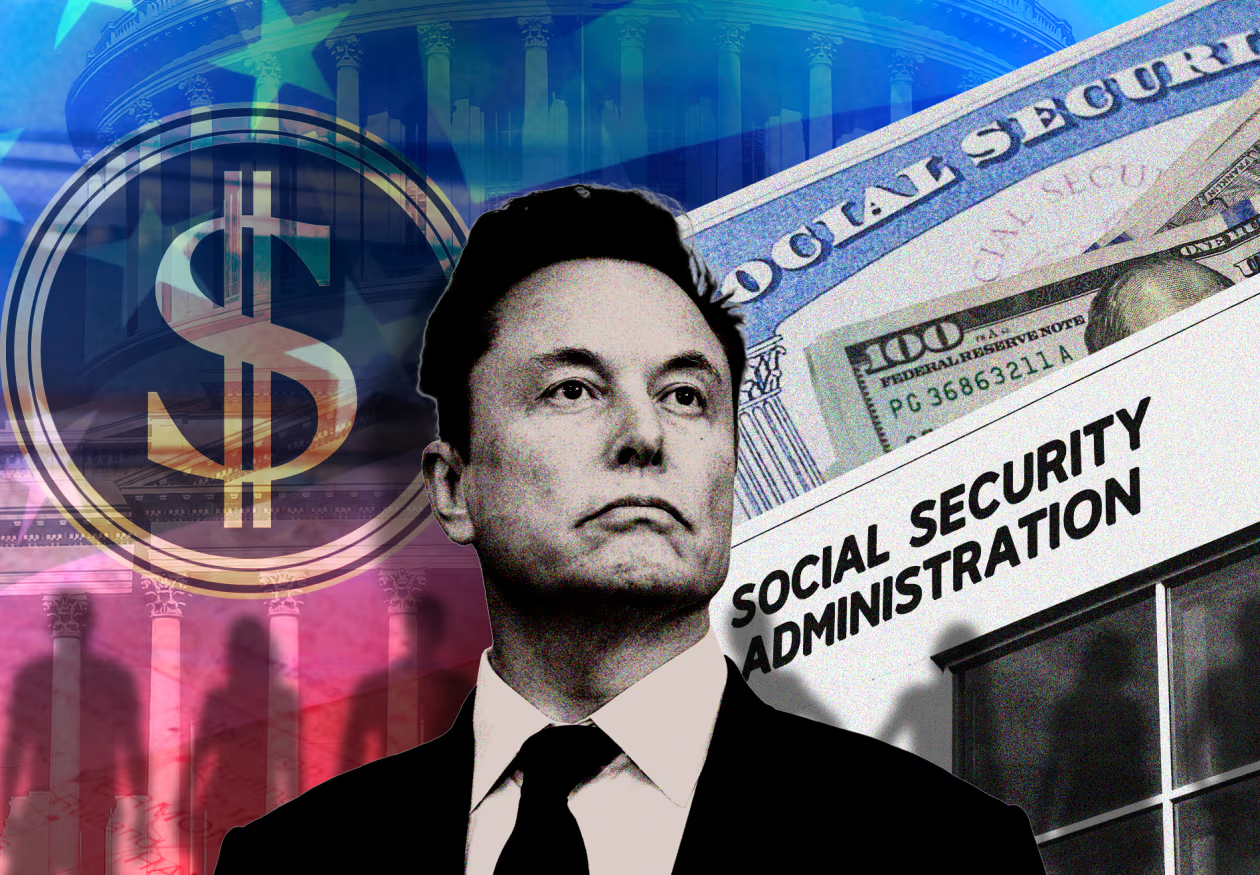
Concerns regarding privacy and the security of America’s pensions have been raised by Elon Musk’s so-called Department of Government Efficiency’s focus on the Social Security Administration. However, experts feel that at least one area is ready for a dose of efficiency, despite recent and unverified claims of fraud.
The amount of money that the Social Security Administration disburses to certain beneficiaries is erroneous each year. The organization occasionally underpays people, but when it overpays, it demands repayment, which might cost beneficiaries tens of thousands of dollars they don’t have right away.
These payments are mistakenly made to an estimated 3 million people annually. Even while the overpayments are thought to represent less than 1% of the overall amount disbursed, they can nevertheless be expensive for the government and the recipients, who frequently have to deal with aggressive attempts to reclaim the money years after they were first given. Instead of targeting beneficiaries’ current and accurate checks, DOGE might focus on those costly errors.
Devin Carroll, a certified financial planner and owner of Carroll Advisory Group, stated, “If they want to get things back on track to stop making these overpayments to begin with, they have to improve their technology infrastructure.”
The Biden administration also attempted to address the long-standing problem of overpayments at the Social Security Administration, or SSA. However, some Social Security supporters doubt that DOGE’s focus on overpayments will lead to changes.
With other government agencies trying to reduce staff and money in recent weeks, DOGE has sparked worries about how it will affect Social Security, which is expected to distribute roughly $1.6 trillion to 69 million beneficiaries in 2025. Earlier last month, supporters of Social Security, including senators and former SSA commissioner Martin O’Malley, gathered outside the agency’s Maryland offices and urged the group to “keep your hands off our Social Security.”
Because the Social Security Administration’s database contains sensitive data, such as employees’ financial and medical records, access to it must be managed carefully, raising security issues. Michelle King, the Acting Commissioner of the Administration, resigned over the weekend after refusing to give DOGE access to the agency’s data. King has been replaced by another SSA employee, Leland Dudek, until President Donald Trump’s choice for SSA Commissioner, Frank Bisignano, is confirmed.
See also: Should you be concerned about your Social Security data being accessed by Elon Musk’s DOGE?
The National Committee to Preserve Social Security and Medicare’s head of government relations and policy, Dan Adcock, stated that Michelle King was against sharing critical information because “they have repeatedly proven their untrustworthiness and they operate in secret.” “We don’t know how they’re using this information.”
A request for comment from DOGE and the Social Security Administration was not immediately answered.
One method to assist the SSA
For many years, the Social Security Administration has mistakenly given certain recipients more money than they were entitled to. The Social Security Administration then demands that the money be repaid, a process known as a clawback.
One of the goals of the Musk-led organization is waste, which is what such overpayments amount to. And for the approximately 3 million people who receive them annually, the way they are now handled can be financially devastating. Some beneficiaries may accumulate tens of thousands of dollars in debt without even realizing it because it frequently takes SSA years to discover the overpayments before recouping the funds.
According to economist Laurence Kotlikoff, co-author of “Social Security Horror Stories,” “this is a government entity that is dysfunctional when it comes to all aspects of operation.” “It can’t even answer the telephone within three hours without hanging up, or giving you some answering phone or callback option that never happens.”
According to Nancy Altman, president of Social Security Works, “the Social Security Administration workforce is at an all-time low,” which is one of the main reasons why the overpayment issue still exists. Employees are in charge of manually entering each person’s updates into the system. “When you’ve got understaffing, it takes a long time to have that happen, so there could be improper payments.”
It would enable the agency hire additional employees who can “in a timely way process claims, answer the phones, do what has to be done,” she said, rather than reducing any portion of the program’s expenses.
Improved technology and the drive for efficiency could make it easier to spot overpayments and enable the agency to do so before beneficiaries’ debt levels skyrocket. However, analysts are concerned that the commission may take more drastic action to recoup the overpayments.
Overpayments may occur for a variety of reasons, including a change in a person’s marital status or living arrangement, the receipt of disability benefits following rehabilitation, or even an error on the part of the agency in determining the amount of benefits that a person should have received.
People who have been impacted are informed that they have been overpaid by a certain sum of money. Beneficiaries have 30 days from the date of the notice, plus five postal days, to reply, according to the agency. The SSA will start collecting benefits to pay back the debt if they don’t.
A nominee for Social Security is ready to update technology.
DOGE and the Trump administration have two primary options for addressing the overpayments problem. The first is by updating the technology used to calculate benefits.
“I would think that addressing overpayments may be an area where the new administration’s focus on technology could improve system integrity,” said Andrew Biggs, a senior fellow at the American Enterprise Institute. “For instance, SSA staff often must enter earnings data by hand; moreover, many overpayments result because beneficiaries don’t submit the earnings data they’re required to.”
“If SSA could tap into more sources of administrative data,” Biggs added, “they would get the information automatically and in near-real time, which would stop many overpayments before they build up into something significant. Therefore, I believe there is a chance that technology use may rise.
Bisignano, the nominee for Social Security Administration commissioner, could be especially well situated to help the program’s systems run more efficiently, Carroll said.
“This commissioner does have a deep history and background in companies that process electronic payments, and if there is anything the Social Security Administration is, it is calculating and processing electronic payments,” Carroll said. Bisignano was previously the chief executive of financial-technology company Fiserv.
Fear of return to aggressive clawbacks
But experts also worry the push for efficiency could result in SSA pursuing a more aggressive approach to collecting overpayments. For years, the agency would take 100% of a person’s benefits until the repayment was met. Those who didn’t have the money to pay upfront could ask to be placed on a payment plan for as long as 36 months. Beneficiaries could also ask for a repeal.
“One of the most difficult parts is what the letter even says,” Carroll said. Beneficiaries would have to try to decipher if the amount the agency is requesting is accurate, looking back at benefit checks from years ago and calculating the totals. “You have to go back to make sense of it. It is hard to make the math work.”
The clawback rules changed during the Biden administration – a limit was set for 10% of benefits per check garnished to repay debts, and individuals requesting a payment plan could have as long as 60 days to respond.
Some experts worry the new administration may change the revised clawback policy as it searches for ways to save the government money and run more efficiently.
“All of that can be reversed in 10 seconds,” Kotlikoff said.
“We believe there are 3 million clawback victims every year,” Kotlikoff said. Moving from 10% of a person’s benefit back to 100% “can be disastrous for literally millions of people.”
On the website for Kotlikoff’s book, readers have shared some of the situations they faced with overpayments. One person was meticulous about budgeting in retirement to ensure it was affordable, but even after checking Social Security benefits three times, received a letter that the Social Security Administration had overpaid by about $15,000. After appealing, that person received a letter saying benefits would be $0 until the debt was repaid in about two years.
Another reader wrote in saying he had notified the Social Security Administration of a situation where he’d be working temporarily after retiring and claiming benefits, which would result in overpayments, but the agency continued to send benefits. Then, after he had paid back that debt, the agency continued to withhold benefits.
A chance for no change
Other Social Security experts say the clawback rules may stay as they are, and the government might find that overpayments slow down with other recent changes. One of the top reasons for overpayments was the Windfall Elimination Provision and Government Pension Offset, which curbed beneficiaries’ retirement, spousal or survivor benefits if they received a public pension in some localities.