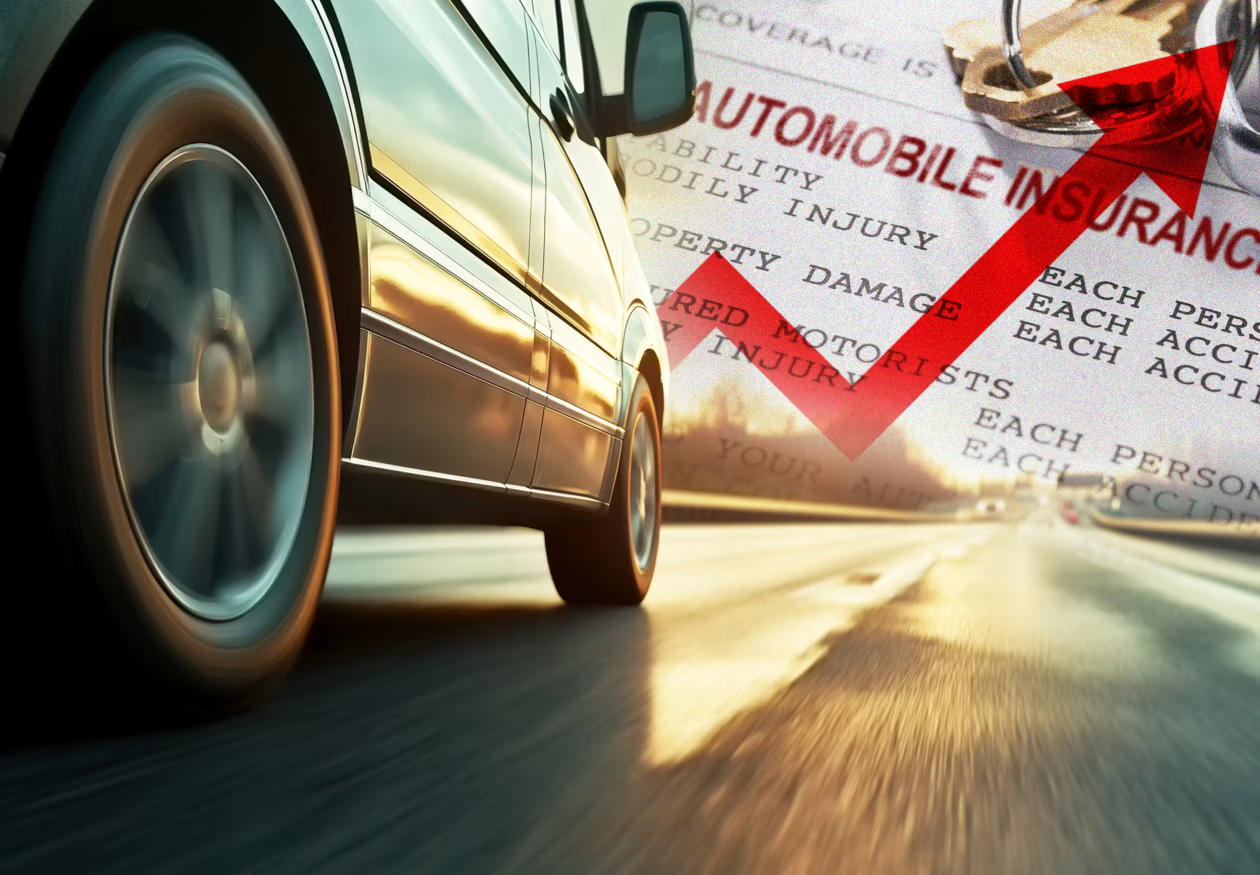
When purchasing road safety insurance, many drivers are taking on greater responsibility and risk due to the combination of growing vehicle insurance premiums and a wider affordability crisis.
Kelly prayed each time she started her car for almost a year.
She had no time to spare and had to travel throughout Houston for work. She would remark something like this when she fastened her seatbelt in her Volvo sedan:
“God, keep an eye on me now since I’m driving this uninsured car once more. I appreciate it if you could make sure I’m safe and that no one hurts me.”
Kelly’s prayers have changed since she received a police ticket in September for driving without insurance, which is prohibited in the majority of states. Just a little. She currently has the bare minimum auto insurance, which might not protect her vehicle in an accident.
“Please just make sure that I am aware of my surroundings and that everyone is aware of me so that I can get there safely and nothing happens to me, my passengers, or my vehicle because I can’t afford it,” she now requests. Lord, I can’t afford it.”
Her prayers represent the extreme of a larger problem that many Americans encounter as a wider affordability challenge and growing auto insurance premiums clash. When purchasing road protection, many drivers have made the decision to take on greater responsibility and risk in order to control their monthly expenses.
More policyholders are paying higher deductibles as a result of drivers shopping around for new plans at record-high prices. More drivers are choosing to pay for repairs themselves after collisions rather than submitting claims, which might raise their insurance rates. An increasing number of drivers have either no coverage at all or insufficient coverage. There is also proof that, in severe situations, more people are attempting to obtain less expensive insurance by cheating insurance firms.
Lower insurance company earnings could result in higher costs for customers even though vehicle insurance prices are expected to level off in 2026.
Insurers may have to include that expense in the cost of providing coverage for their own clients as more drivers on the road take on greater risk. Increased risk and higher pricing might reinforce one another in this cycle.
In her early 40s, Kelly had considered auto insurance a “non-negotiable” expense for decades. However, following Hurricane Beryl in July 2024, she lost her work and ultimately allowed her insurance to expire in order to keep her expenses under control.
Kelly wanted to continue her coverage with her insurance, Progressive, after discovering her present position dealing with clients who have mental health problems. However, despite a three-year safe driving record discount, her coverage lapse and poor credit score caused her quoted rate to increase to $476 per month.
Compared to her prior $263 monthly premium for full coverage, that would have represented a more than 80% rise. In a budget where housing and bills already consumed more than half of her monthly take-home pay, it would not have been feasible. Additionally, the $605 monthly loan payments on her seven-year-old Volvo were almost equal to that amount. A request for comment from Progressive was not answered.
“At that point, it became quite evident to me that purchasing insurance for myself would practically prevent me from going grocery shopping so that my kid and I could have dinner at night. I apologize, but I simply am unable to. I will not deny my child food in order to obtain insurance.
“I will not forgo feeding my child in order to obtain insurance.”
Texas and all states except New Hampshire have laws requiring drivers to carry auto insurance. (In the event of an at-fault collision, Granite State drivers must demonstrate financial accountability.)
Kelly received her ticket and, eventually, her new policy after being stopped by the police while returning from a client appointment due to an invisible registration sticker. If she is found to be at fault, her liability-only policy covers the damage to another vehicle. Although it is somewhat less expensive than her prior policy at $215 per month, it only offers a small portion of the coverage she previously had.
Kelly’s entire identity is being withheld by MarketWatch for privacy reasons, but they have access to her insurance records and a copy of her police ticket.
Kelly was among the increasing number of Americans without auto insurance for the more than 12 months she was uninsured. According to the most recent data from the Insurance Research Council, which is backed by associations and corporations that provide property and liability insurance, over 15% of drivers were uninsured as of 2023. According to data from the Insurance Research Council, the percentage of drivers without insurance increased between 2019 and 2023.
According to the National Association of Insurance Commissioners, the average yearly cost of comprehensive auto insurance increased from $1,207 to $1,438 during that time.
In addition to fears about whether they are sufficiently covered, drivers continue to worry about the amount of their insurance bills as the new year approaches. Experts think there’s probably no turning back anytime soon.
“We’re playing whack-a-mole with problems and solutions,” stated David Seider, chief commercial officer of TheZebra.com, an online marketplace for vehicle insurance.
Drivers can reduce their monthly price by raising their deductible, but will they be able to pay for accidents? Pay-per-mile pricing and other newer coverage types may be less expensive, but can a driver keep within the limit?
Seider doesn’t think the trends will change next year if household income isn’t sufficient to cover insurance premiums. “We just don’t see the indications that anything is going to come down that much,” he stated.
“A significant downturn in premiums across the board is very unlikely,” stated Gerry Glombicki, a senior director in the North American insurance division of Fitch Ratings.
According to LexisNexis Risk Solutions, Americans set a record in 2024 for the amount of time they spent shopping for new auto insurance plans. 2025 might end up surpassing 2024.
According to the files that major insurers submitted to state regulators, premiums might marginally decrease in 2026, according to Jeff Batiste, senior vice president and general manager for U.S. car and home insurance at LexisNexis. yet “that still is not getting relief fast enough to consumers,” he stated. As drivers look for better bargains and insurers compete for clients, he anticipates that high rates of shopping around will persist beyond 2026.
In 2026, Kelly is looking for more affordable coverage. She will need to continue praying with each spark since she is doubtful she will locate it. Here are some reasons why drivers will continue to be negatively impacted by auto insurance costs, which will probably lead them to place more risky wagers in the upcoming year.
In 2026, auto repairs won’t get any less expensive.
This year’s hikes in auto insurance premiums were less severe than the prolonged spikes in 2023 and 2024. However, that didn’t make coverage any less expensive; it simply indicates that the increases happened more slowly.
Think about a windshield crack. In the past, fixing one required putting in new glue, rubber gaskets, and glass. The more advanced cars of today frequently feature cameras and sensors that need to be taken out and sometimes replaced. “More and more features that add to the cost of repair,” stated Bob Passmore of the trade association American Property Casualty Insurance Association.
According to Passmore, the group’s department vice president for personal lines, the expected cost of repairs is the primary consideration for companies when setting premiums. According to him, the cost of auto parts increased by 40% between 2020 and 2025, which resulted in a 20% increase in repair costs. In order to cover their expenses and the possibility of more costly repairs, insurers raised premiums when inflation increased and drivers resumed driving following the pandemic.
“Those expenses are not decreasing. “In terms of the cost to repair new vehicles, this is probably the new normal,” Passmore stated, adding that they are just not growing as quickly as they once did.
Tariffs imposed by the Trump administration are another factor driving up costs. According to the insurance trade organization, over the course of the next 12 months, drivers and the industry may have to pay an additional $16 billion to $31 billion in claims expenses.
The additional technology in modern cars is frequently designed to reduce the probability of collisions, which should reduce the likelihood of insurance involvement. “I’m not sure that has really worked its way through the numbers yet,” Glombicki stated.
According to LexisNexis Risk Solutions, fewer collision and property-damage claims were filed through the third quarter than in 2022. However, throughout that time, the “severity” and cost of these claims have gone up.
Naturally, someone must be able to do these intricate repairs. According to Glombicki, 60% to 70% of a claim’s expenses are related to a mechanic’s work.
However, there are not enough skilled technicians. The National Automobile Dealers Association estimates that there is an annual shortage of about 37,000 qualified technicians. “To repair a car in 2026 is going to be more expensive than in 2025, just by labor costs,” Glombicki stated.
Drivers’ deductibles have increased.
According to data and experts, drivers are increasingly placing themselves at risk of paying more before their insurance company intervenes to make a check. One strategy for reducing monthly premiums is to enroll in a plan with a larger deductible.
According to data from Mitchell International, a software provider for insurance companies and collision repair businesses, the average car insurance deductible for Americans was $831 as of early December, up from $619 in 2019. Since the beginning of 2025, the average deductible has increased by almost 2%.
According to Ryan Mandell, vice president of strategy and market intelligence for Mitchell International, a collision-claims software company, deductible averages probably won’t fall below $800 in the upcoming year.