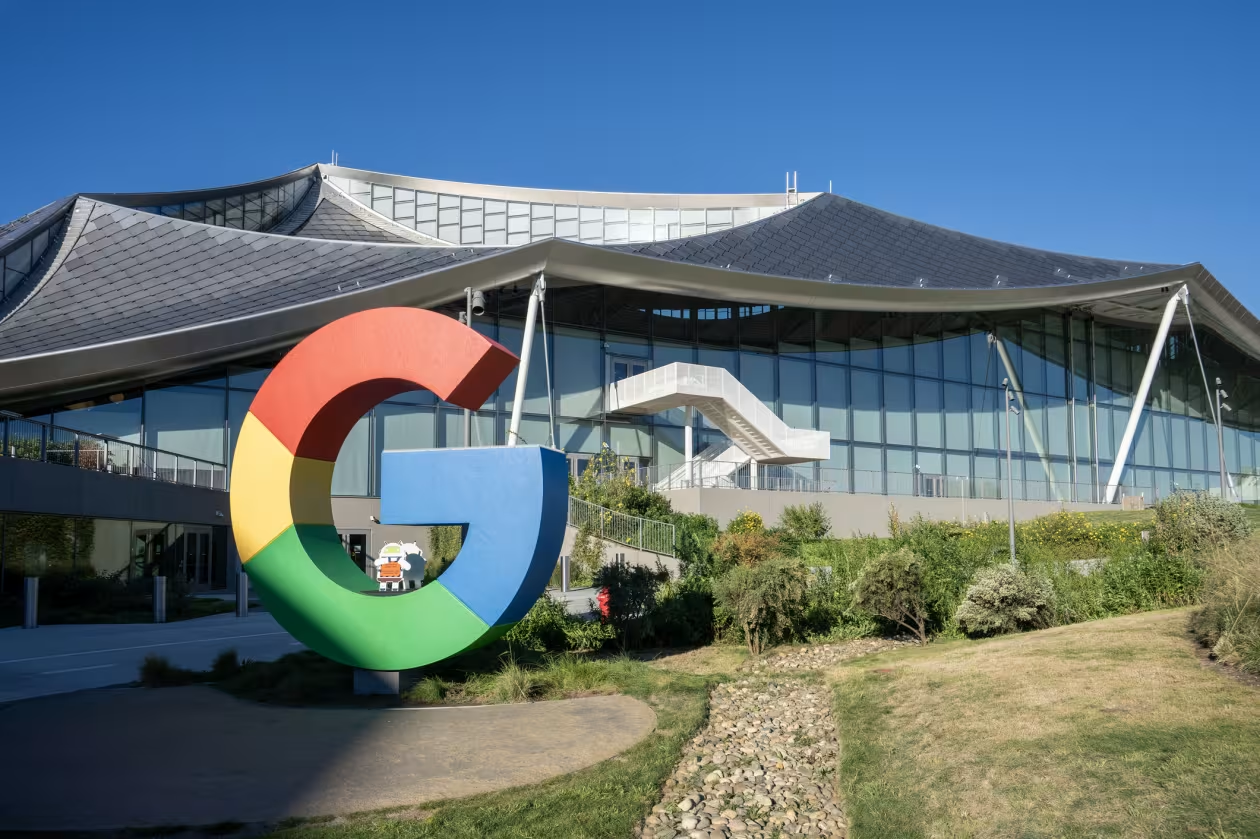
In Texas, Google and Intersect are presently constructing a co-located facility where the power plant and data center are housed on the same campus.
Alphabet has taken a bold step to increase its energy resources since the demand for artificial intelligence computing keeps growing faster than data centers and electricity providers can keep up.
Alphabet (GOOGL) (GOOG) stated on Monday that it has acquired Intersect Power, a developer of renewable energy, for $4.75 billion in cash plus the assumption of its debt.
“The acquisition will enable more data center and generation capacity to come online, faster, while accelerating energy development and innovation,” Alphabet stated in a news release.
Together with the climate investment division of alternative asset manager TPG, Alphabet led a $800 million funding round for Intersect last year, acquiring a minority share in the company. In addition to assigning Intersect the responsibility of creating new technologies to increase the energy supply for data centers in the United States, Google is purchasing the company’s personnel and gigawatts of ongoing collaborative projects.
In Haskell County, Texas, Google and Intersect are now building a co-located complex, which would place the power plant and data center on the same property.
Sheldon Kimber, Intersect’s current founder and CEO, will continue to oversee the company’s operations independently of the rest of Google. The deal, which is anticipated to finalize in the first half of 2026, excludes Intersect’s ongoing business activities in Texas and California, including development projects with a California base.
The acquisition won’t have an immediate effect on Alphabet’s financials, according to a note from BNP Paribas analyst Nick Jones on Monday, but he thinks “it helps strengthen Alphabet’s long-term AI infrastructure positioning by improving control over energy sourcing and capacity expansion.”
“Overall, we view the deal as a prudent investment to support further AI and cloud growth from here,” Jones stated.
Since AI has pushed the boundaries of a U.S. energy grid that has seen essentially flat demand for the two decades prior to 2020, energy has become a hurdle for the technology’s progress. Increasing access to energy has become a top priority as the Trump administration has made AI a major national security concern.
“The foundation of American competitiveness in AI is modern infrastructure. In the press announcement, Kimber of Intersect stated, “We share Google’s belief that energy innovation and community investment are the pillars of what must come next.”
Google has previously ventured into the energy infrastructure space. Google participated in a $3.7 billion acquisition in August with the AI cloud platform Fluidstack and TeraWulf (WULF), a cryptocurrency miner that is now a high-performance computing supplier. Fluidstack’s leasing payments to TeraWulf were first backed by Google at a cost of $1.8 billion, but then increased to $3.2 billion.
By lowering TeraWulf’s development risk, Google assisted the former bitcoin miner in obtaining a $3.2 billion debt financing package in October.
Commonwealth Fusion Systems, a nuclear-fusion firm, has received support from Google and Nvidia (NVDA) to investigate alternate energy sources.
By increasing its presence in every aspect of the ecosystem, from data center infrastructure to its top large language model, Gemini, Google has become an AI giant this year.
Alphabet’s stock has increased by 63.2% in 2025, making it the top-performing of the “Magnificent Seven” internet behemoths this year.