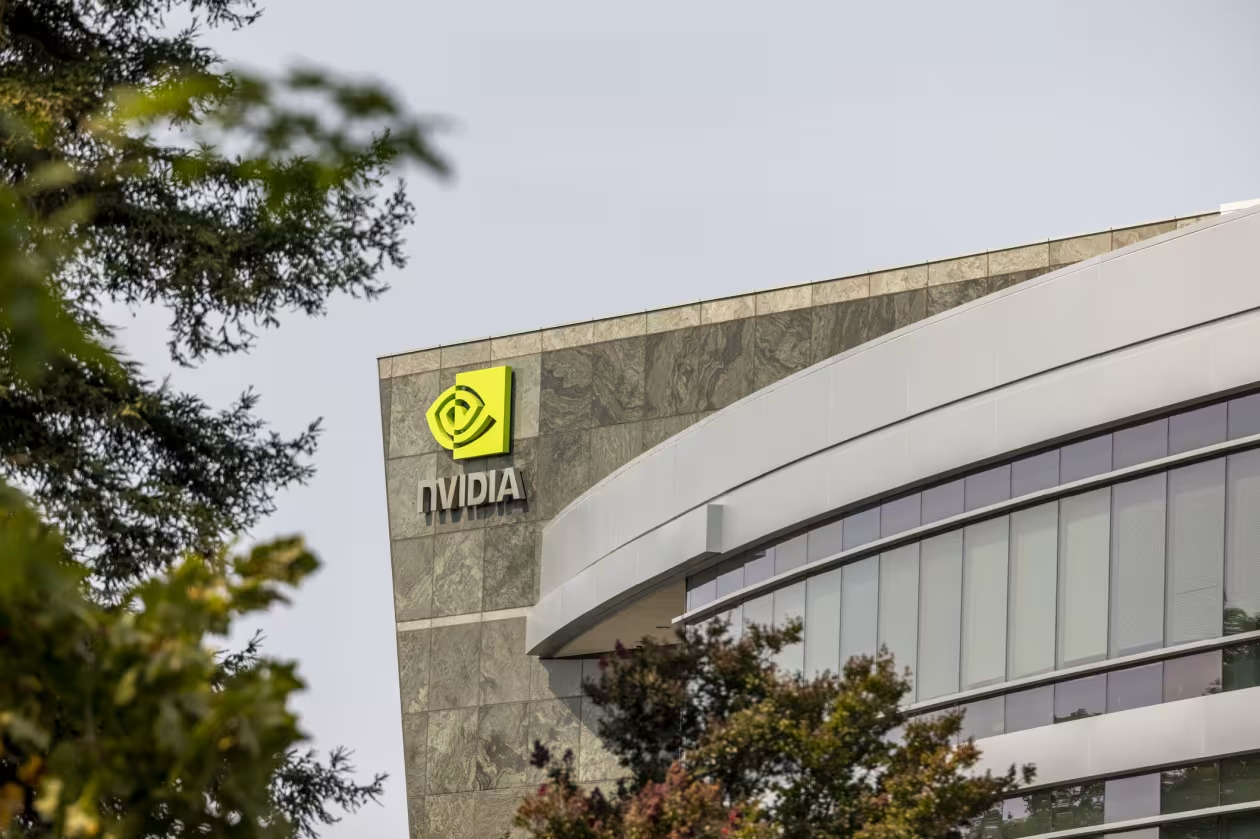
The recent setback to Nvidia Corp.’s China division has Wall Street analysts questioning the company’s prospects for expansion.
The U.S. government will need a license to export its H20 chip, which was sold to China, Hong Kong, and Macau, the semiconductor maker said late Tuesday. “You can tell the company isn’t counting on any such ‘licenses’ being granted from this date forward,” Melius Research analyst Ben Reitzes wrote in response to Nvidia’s (NVDA) announcement that it will write off around $5.5 billion in H20 inventory for the April quarter.
On Wednesday, Nvidia’s shares dropped around 7%.
What the loss of the China business means for Nvidia’s future is the topic at hand. As the company capitalizes on the high expenditure from Big Tech clients, Reitzes is confident in his prediction that it would be able to sustain sequential growth throughout the year.
“It seems (for now) that capex spending from US hyperscalers for Nvidia chips looks solid at Google, Amazon and Meta,” Reitzes stated. “While Microsoft has been sending signals of a big deceleration in data center buildouts, its spending for compute should still be solid.”
With the help of its Blackwell offering ramp, he believes Nvidia can report revenue upside for the April quarter before experiencing 10% sequential growth in the July quarter and 7% sequential increase in the October quarter.
One “silver lining” for Nvidia is that, following the new government regulations, the company may see some improvement because the H20 probably had “much lower” growth margins than other graphics processing units in its portfolio.
Blayne Curtis, an analyst at Jefferies, was less certain that Nvidia would report sequential growth throughout the year. “Sentiment was already fairly low for the July quarter given concerns that the GB200 ramp continues to be slow but this new headwind makes sequential growth much more difficult,” he stated in a client note.
According to Curtis, completed or partially completed products account for almost half of the write-down. According to his calculations, that amounts to an unrecognized revenue of maybe $10 billion.
“We don’t know when that lost revenue was to be recognized but we could see a headwind of $5B in the July quarter (vs April),” he stated.
According to Curtis, Nvidia also runs the potential of increased pressure from the Biden administration’s artificial intelligence “diffusion” regulations.
That worry was also brought to light by Stacy Rasgon of Bernstein.
“These rules would require Nvidia’s non-U.S. customers to obtain a license to purchase more than a small amount of AI parts,” he stated. Nvidia’s outlook for the fiscal second quarter and the second half of the year states, “Although we think these rules are ultimately manageable, we do not know how long it will take to process and obtain appropriate licenses, and (if the rules are put into place) the regulations have the potential to impact.”
He went on to say that although he had previously thought there was a slim possibility those regulations would be implemented, the H20 development has made him “no longer so sure.”