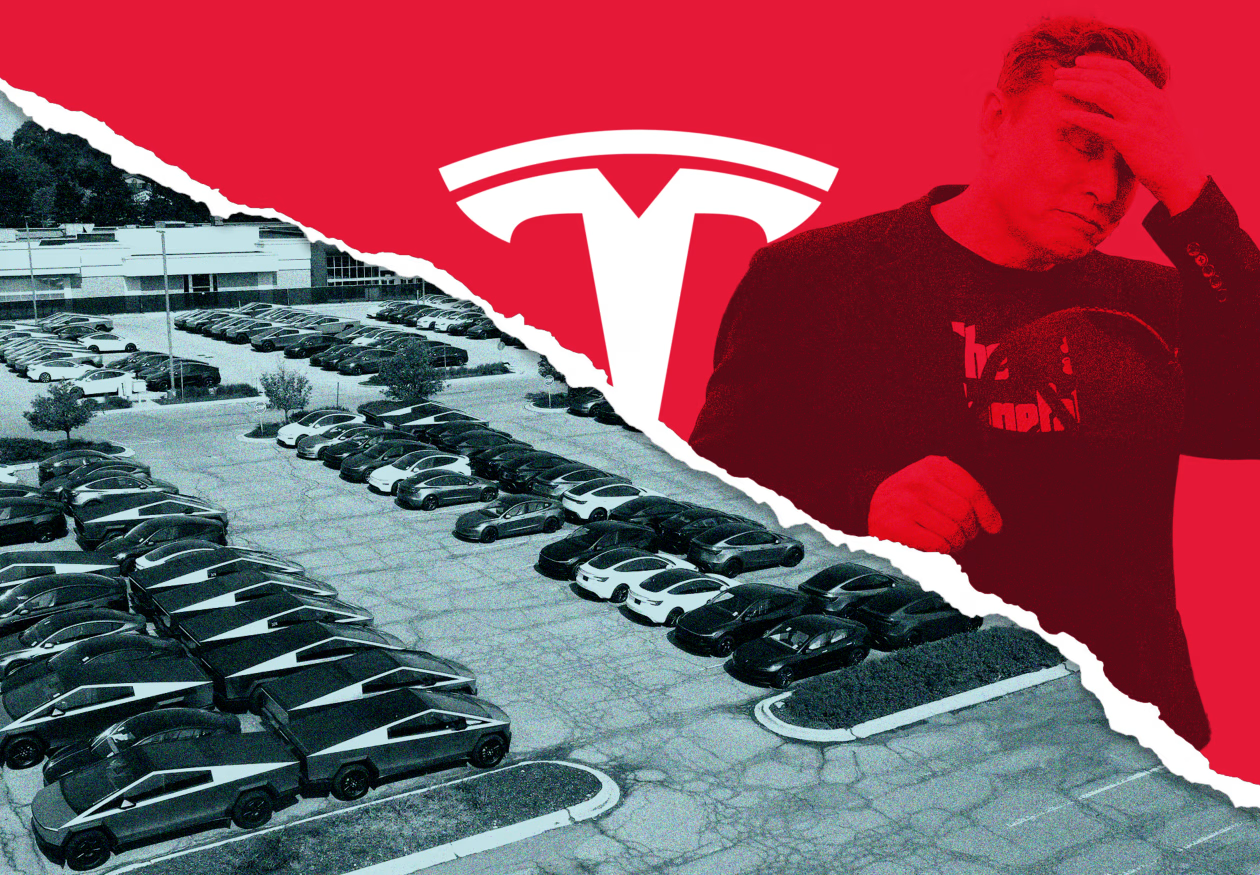
For its primary electric vehicle business, Tesla has had a difficult year. In 2026, that is anticipated to continue, but analysts see a few opportunities for improvement.
As the electric vehicle company doubles down on artificial intelligence and automation, investors are expecting even greater things from Tesla in 2025, which is coming to a close on a high note.
The stock (TSLA) has recovered despite a difficult start to the year as CEO Elon Musk courted controversy at every turn. It closed Monday at $488.73 after hitting a record intraday high of $498.83. Through Wednesday, shares had risen 20.2% in 2025, above the 17.9% return in the S&P 500 index.
Analysts say that investors’ perception of a future dominated by humanoid robots and self-driving cars is mostly responsible for that rise. Wedbush analyst Dan Ives is one of the most bullish, predicting that Tesla’s “monster year ahead” might culminate in a $3 trillion valuation, which would roughly double the company’s current market capitalization of $1.6 trillion, and determine its destiny.
Tesla’s idea for a ride-hailing network, which enables customers to request autonomous cars to pick them up and drop them off without the need for a driver, is where it all begins. In June, the business launched its “robotaxi” service, starting in Austin, Texas, which is where it is based.
There isn’t much that sets Tesla apart from Uber Technologies (UBER) or Lyft (LYFT), although it does currently provide certain ride-hailing services in Austin and the San Francisco Bay Area. Currently, the service provides travel in Model Y sport-utility vehicles with Full Self-Driving, an advanced driver-assistance system, under the supervision of an employee.
By the end of 2025, Musk has set lofty goals for the location of Tesla’s robotaxi network, which officially started in Austin in late June. It’s realistic to assume that Tesla will fall short of those goals with only a few days left in the year.
According to CFRA analyst Garrett Nelson, “we’ve seen Musk overpromise in terms of the timing of when certain products or services might be available.” “We’re expecting that to be the case with robotaxis as well.”
By the end of the year, Musk has stated that Tesla intends to operate in at least eight major cities, including Phoenix and Las Vegas, and significantly grow its present fleet in Austin and San Francisco. Additionally, Musk plans to remove safety monitoring from cars by the end of December, and Tesla is conducting unsupervised excursions in Austin.
According to a crowdsourced robotaxi tracker, Tesla has only about 160 vehicles in active usage and has not yet launched in other cities, despite its objectives. In Austin, where Musk stated that Tesla’s fleet would increase to roughly 60 vehicles by the end of the month, just a small number of cars have been added to the network.
However, over time, investors have grown accustomed to Musk’s overpromising. According to Morningstar analyst Seth Goldstein, this is one reason why they probably won’t care about Tesla’s robotaxi delays as long as there is some discernible progress.
This is demonstrated by the fact that, despite Musk’s robotaxi ambitions probably not being met, Tesla’s stock is expected to close the year at record highs.
One factor contributing to the delays, according to Goldstein, is Tesla’s strong emphasis on safety, as hazardous events could compel it to stop testing, as was the case with General Motors’ (GM) former robotaxi subsidiary.
“I think they want to be extra cautious, extra careful and make sure that when they enter a market, they do so very effectively,” Goldstein stated.
Regarding how far Tesla would expand its robotaxi operations in 2026, analysts are split. Barclays and Truist Securities analysts have stated that it will be unknown and cautioned about stock volatility because of how it and competitors like Waymo, which is supported by Alphabet (GOOGL), will grow in the upcoming months.
While Morgan Stanley and other analysts have adopted more conservative predictions, Deutsche Bank has stated that Tesla could have a fleet of over 2,500 vehicles by June, provided it meets Musk’s 1,500 vehicle objective earlier in the year. Although it’s uncertain when it would be available for use on American roads, Tesla’s Cybercab robotaxi vehicle is also scheduled to go into production in 2026.
A “wild card”
Full Self-Driving, or FSD, the company’s cutting-edge driver aid technology, is the foundation of Tesla’s robotaxis. Adoption has been sluggish despite the company’s years-long promotion of the package and Tesla’s substantial data collection.
Only 12% of Tesla customers were paying to have FSD enabled on their cars as of the third quarter. If Tesla is successful, it might be able to significantly enhance adoption the next year, generating more income, training data, and potentially increasing sales.
According to Musk, FSD will “hopefully” be made available in the United Arab Emirates next month, marking the company’s first Middle Eastern market. Additionally, he anticipates that FSD will be completely approved by Chinese regulators “around February or March,” which should enable Tesla to compete with rivals that provide comparable technologies.
According to Goldstein, FSD certification will be a “wild card” in Europe. The technology may be approved in the Netherlands if Dutch officials evaluate it in February.
According to Tesla, other EU countries will be able to accept that exemption if FSD is approved in the Netherlands. The business then stated that it would request formal software approval from a European Union committee.
That might help boost sales in the 27 EU member states, where Tesla’s sales have decreased by roughly 39% year-over-year as of November and the business is dealing with more competition. Tesla’s sales in China had decreased by 9% from the previous year.
With what Musk has described as a few “rough” quarters ahead for sales, it is anticipated that Tesla’s U.S. sales will decline by 9% in 2025. This is mainly because some consumers have already started to reduce their use of EVs after the United States eliminated a tax credit that previously encouraged the purchase of electric vehicles.
However, according to some analysts, that might eventually work to Tesla’s advantage.
“The only companies in a position to maintain or increase [market] share are those with robust products, cost control, and loyalty. In a recent report, Canaccord Genuity analyst George Gianarikas stated, “That’s good for Tesla.”
Considering the future
Additionally, Tesla plans to start producing a small silicon chip and a line of humanoid robots, two items that could shape the company’s future.
According to Morgan Stanley forecasts, the market for humanoids might reach $5 trillion by 2050, with the technology accelerating in the mid-2030s. Musk has suggested charging roughly $30,000 for the Optimus robot, which could eventually make up 80% of Tesla’s worth and be used in homes and industries.
However, Tesla still has a ways to go before it becomes a reality. The business has struggled to get parts and develop the hands and forearms of its robots.
“So with cars, you’ve got an existing supply chain,” Musk stated back in October. “There is already a supply chain in place for computers. There is no supply chain when using a humanoid robot.
According to Musk, a prototype of the third iteration of Optimus that will be produced in large quantities should be prepared for a demonstration by March.
Nelson of CFRA and others are eager to find out more about Tesla’s Optimus roadmap. However, he stated that it is still a “back burner-type” product and is not likely to start boosting Tesla’s profits anytime soon.
Go further: Elon Musk claims that one little but costly idea is the foundation of Tesla.
The AI5, a next-generation semiconductor that Tesla intends to start producing in late 2026, will power those robots as well as data centers and robotaxis. According to Musk, the AI5 outperforms competing CPUs from Nvidia and is a major upgrade over the current AI4.
“We’re going for radical simplicity,” Musk declared in October. “The net effect is that I think AI5 will be the best performance per watt, maybe by a factor of two or three, and best performance per dollar for AI, maybe by a factor of 10,” compared to competing chips.
Production of new energy products and a long-awaited update on plans for a next-generation sports car are also on Tesla’s 2026 agenda. After years of delays, the all-electric Tesla Semi truck is also anticipated to go into mass production in the second half of 2026.